In the upcoming years, it will be imperative for many different industries to implement computer vision based perception technology like LiDAR to help identify safety issues, minimize risk, and improve operations.
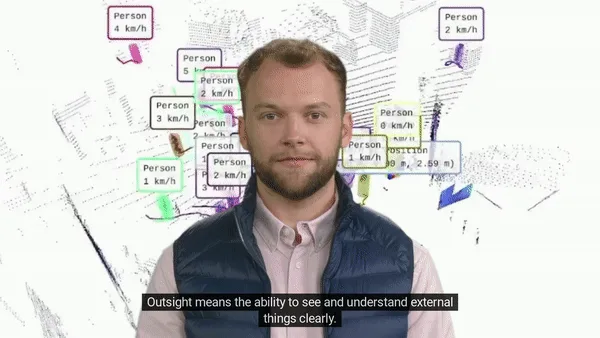
To answer these needs, our 3D LiDAR based software delivers actionnable real time data from any LiDAR sensors, to provide unique insights that cannot be obtained with cameras.
We’re really proud to be a part of this selection ! Congratulations to the whole team!
Drop your email and we'll get back to you as soon as possible.
Frequently Asked Questions
Why are investors paying attention to LiDAR software companies in 2023?
LiDAR sensor prices dropped sharply as automotive-grade production scaled, pulling the cost of deploying LiDAR in infrastructure-based applications down with it. Investors following that curve recognized that software companies able to process multi-vendor 3D point clouds at scale were positioned to capture the non-automotive market before it consolidated. The infrastructure segment, airports, cities, factories, spans a much larger total addressable market than the automotive vertical that originally funded LiDAR hardware development. Outsight's recognition among the top 100 startups to invest in reflects that thesis: the company's SHIFT platform processes 3D LiDAR data across deployments at Dallas Fort Worth, BMW factories, and smart-city intersections, demonstrating that infrastructure-scale demand is real and already generating enterprise contracts.
What makes 3D LiDAR data different from what a standard computer vision camera provides?
A standard camera captures a 2D grid of pixels with no inherent distance information. A 3D LiDAR sensor emits laser pulses and measures how long they take to return, producing a point cloud where every point carries an x, y, z coordinate. That depth layer enables precise tracking of object size, speed, and trajectory without requiring controlled lighting, and without capturing faces or license plates. Shape and motion are extracted directly from geometry rather than inferred from image texture. Outsight builds on this property at infrastructure scale: its SHIFT platform processes LiDAR point clouds in real time, under 50 milliseconds end to end, to generate anonymous 3D representations of how people, vehicles, and robots move through physical sites, without ever recording biometric data.
Which industries are expected to adopt LiDAR-based perception the fastest after automotive?
Airport and transportation infrastructure, industrial automation, and smart cities are the segments where production-scale LiDAR deployments are already operating. Airports compress several urgent problems into one site: safety compliance, capacity limits, and passenger experience, all of which require accurate real-time spatial data. Outsight's infrastructure-based deployments reflect this pattern, spanning major airports such as Dallas Fort Worth and Paris-Charles de Gaulle, BMW factories, and smart-city intersections in Bellevue, Washington, where LiDAR supports Vision Zero pedestrian safety programs. Industrial sites add worker safety and autonomous mobile robot coordination as further drivers of rapid adoption.
Can a single LiDAR software stack handle sensors from different manufacturers in the same deployment?
Multi-vendor compatibility is a core requirement for real-world deployments, where a site may carry sensors from several manufacturers installed at different times or chosen for different performance characteristics. Outsight's SHIFT platform supports more than 210 LiDAR models across leading manufacturers, including Hesai, RoboSense, Ouster, Velodyne, and Seyond hardware. The software normalizes the raw point cloud output from each sensor into a common format, so downstream tracking and analytics pipelines treat all sensors the same regardless of origin. This approach matters especially in large-scale infrastructure environments, such as the Dallas Fort Worth airport deployment, where sensor diversity across terminals and concourses is unavoidable and a unified software layer is essential for consistent real-time perception.
How does LiDAR-based perception handle safety use cases that cameras struggle with?
Cameras degrade in low light, direct glare, and crowded scenes where people occlude each other from a 2D perspective. LiDAR is an active sensor that generates its own light, so darkness and strong ambient light have no effect on measurement quality. Its 3D point cloud also captures depth, which means two people standing in front of each other are represented as two separate volumes at distinct distances rather than as overlapping pixels. That makes fall detection, near-miss events, and perimeter intrusion more reliable in the conditions where safety incidents tend to cluster. Outsight applies this principle at infrastructure scale through its SHIFT platform, processing 3D LiDAR data with a sub-50ms end-to-end pipeline across deployments in airports, train stations, and security-sensitive facilities such as datacenters.
Is LiDAR software recognition by business press a signal of market maturity or just hype?
Selection by a mainstream business publication reflects that a technology has moved from specialist engineering press into the broader investment conversation, which typically happens when a category crosses from pilot deployments into repeatable commercial contracts. For LiDAR software specifically, the signal aligns with independent analyst recognition: Outsight has been cited seven times by Gartner as a category-defining emerging leader in Spatial Computing and Digital Twins, alongside awards from Frost and Sullivan and the Edge AI and Vision Alliance. That spread across trade, analyst, and financial audiences is a stronger indicator of market maturity than any single accolade, suggesting the category is consolidating around infrastructure-scale deployments rather than remaining in an experimental phase.