- LiDAR technology is a strong emerging trend in the Computer Vision landscape: over $3 billion have been invested in the Hardware aspect of LiDAR technology since 2019 and only the top five American LiDAR Hardware Manufacturers are expected to grow from less than $150 million sales in total in 2020 to over $4 billion in 2024.
- However, effectively using LiDAR data in real-time is a complex, expensive and long endeavor even for the best 3D expert engineers. Assessing and selecting the right hardware among the profusion of dozens of manufacturers without any standard makes it even more challenging and threatens to slow down market adoption.
- In that context, software for LiDAR is expected to account for at least 50% of the value and over 65% of gross profit across many markets: integrators and solution providers that are not 3D experts require a processing solution that solves the complexity of using LiDAR data regardless of the hardware supplier.
PARIS–(BUSINESS WIRE)–Outsight, the pioneer of 3D Spatial Intelligence solutions, announced today the launch of a game-changing product: a full Spatial Intelligence platform based on Lidar technology.
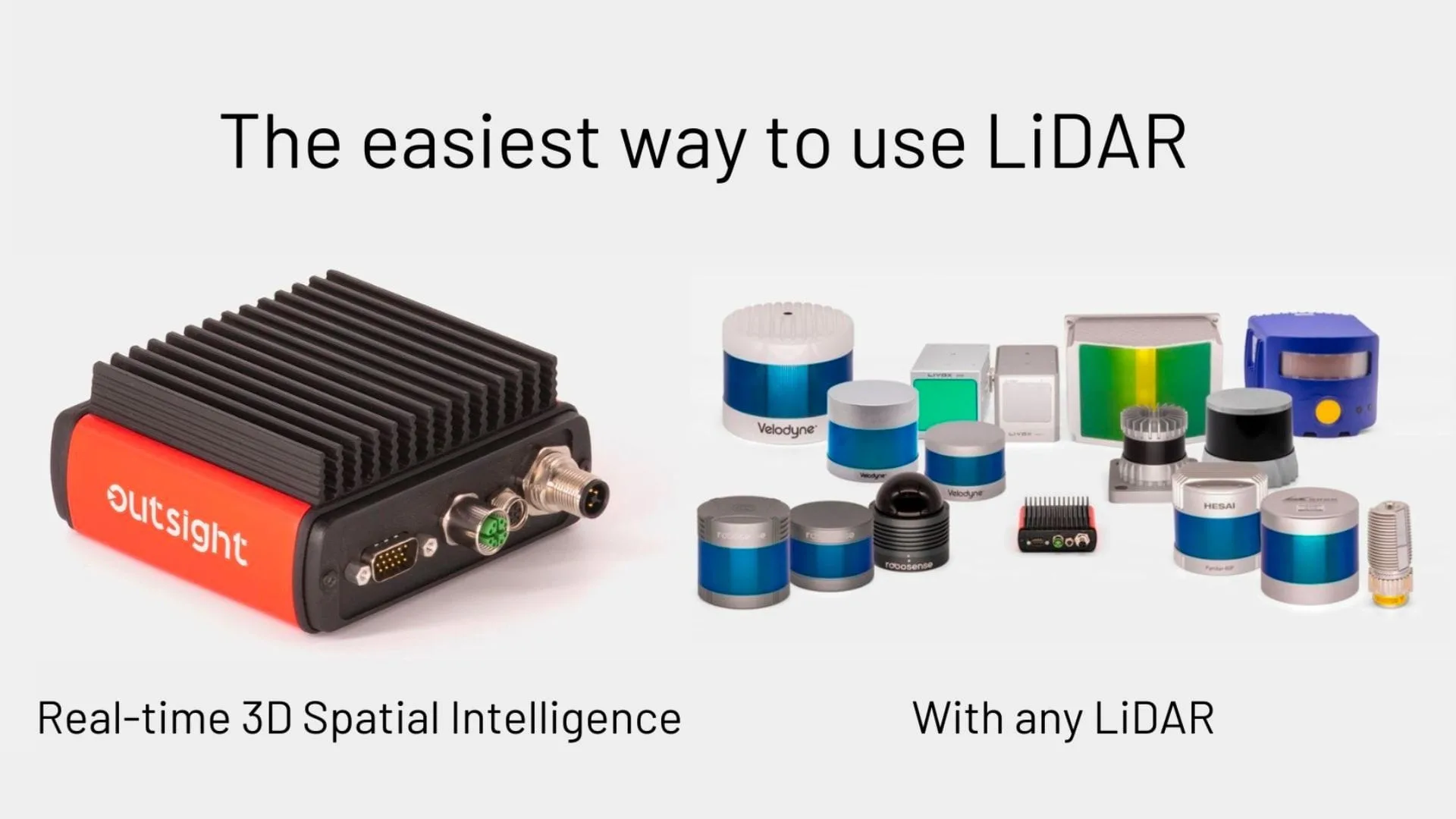
It’s the first real-time LiDAR Software Engine that allows application developers and integrators to seamlessly use LiDAR data from any hardware supplier.
Created as a turnkey solution, it enables leveraging 3D Spatial Intelligence’s unique value while avoiding the complexity of processing 3D data in real-time.
Being a LiDAR-agnostic solution, it saves the customer the hassle of assessing and choosing the most appropriate LiDAR for each application. LiDAR can now be easily used by everyone!
This new product offering follows thorough early customers’ validation processes across several different markets (Robotics, Automotive, ITS, Security & Surveillance), geographies (USA, Europe, Asia) and user profiles (Market-leading corporates, Start-ups and Universities) as well as strategic partnership agreements and collaborations with the most prominent LiDAR suppliers in the USA and Asia, including Velodyne (NASDAQ: VLDR), Ouster (NYSE: OUST), Hesai, and Robosense.
Whether it is for monitoring the flow of people or goods, builders of Mobile Robots & Vehicles as well as Integrators of Solutions are increasingly interested in leveraging the unique value of real-time 3D Spatial Intelligence that LiDAR technology creates, but don’t want to deal with the complexity of processing RAW LiDAR data.
Moreover, for the best professionals in most applications, going through the hassle of assessing, selecting and using the right LiDAR sensor out of dozens of hardware suppliers and more than a hundred available products, without any standard, is also a time-consuming, non-value added and inefficient use of engineering resources.
Turning any LiDAR into a Spatial Intelligence device
The solution is a real-time software engine that turns any LiDAR into a Spatial Intelligence device.
It overcomes the complexity of using RAW 3D data, so any application developer or integrator can efficiently use LiDAR in its own solutions without needing to become a 3D LiDAR expert.
It provides a comprehensive set of fundamental features that are commonly required in almost every application (e.g., Localization& Mapping, 3D SLAM, Object ID & Tracking, Segmentation & Classification, among others).
Because it only requires an ARM CPU and its AI doesn’t rely on Machine Learning, the solution is power-efficient and doesn’t need any Training or Annotation efforts.
According to Raul Bravo, President and co-founder of Outsight: “The hardware aspect of LiDAR is becoming a commodity with prices decreasing very quickly together with impressive performance improvements.
However, this new animal in the Computer Vision landscape remains a complex technology for most customers to use. As it happened every time in modern-day History of technology adoption, we’re convinced that the key condition required for LiDAR to become mainstream is the emergence of enabling software.”
LiDAR-agnostic
There is no LiDAR hardware that can fit all applications and contexts: the company has built an enabling computing layer, performing all required task regardless of the end-user application and LiDAR supplier, so integrators and solution providers are not constrained by the limitations of specific sensors.
A new standard adopted by the leaders of the market
The company has seduced not only leading customers in fields such as Smart City, Robotics and the Automotive industry, but has also established strategic partnerships with the world’s most renowned LiDARs manufacturers, such as American leaders Velodyne (NASDAQ: VLDR) and Ouster (NYSE: OUST), or the Chinese Hesai and Robosense.
The launch also follows the successful deployment of Outsight’s technology at Paris Charles de Gaulle airport of the ADP group, to provide accurate real-time monitoring of people flow while preserving private data.
Outsight has grown rapidly by integrating new features into its LiDAR-based processing solutions that enable systems to perceive, understand and interact with their surroundings in real time.
With a new generation of hardware and software pre-processing engine, connected to any LiDAR of the market, Outsight offers a unique level of simplicity, efficiency and versatility.
Award-Winning Technology
In less than a year, Outsight has successfully designed and industrialized this new generation of LiDAR processing solutions, which has been the subject of 63 patent applications.
Outsight’s innovation won many awards, including the prestigious Best of CES Innovation Award in Las Vegas, and it’s the youngest company ever to have won the Prism Award by the world leaders in photonics.