Skip to content
Insights
ADR chooses Outsight for Large Deployment

Aeroporti di Roma to deploy Outsight's Physical AI solution at scale across Rome Fiumicino Airport

Aeroporti di Roma (ADR) is expanding its collaboration with Outsight to a large-scale deployment across almost all Schengen common-use areas at Rome Fiumicino Airport.


Rome & Paris 23 April** 2026 –** Aeroporti di Roma (ADR) and Outsight, a leading provider of Spatial Intelligence solutions based on Physical AI and 3D Lidar data, today announced a major expansion of their collaboration to enhance operational efficiency, passenger experience and data-driven decision-making at Rome Fiumicino Airport.

This deepened collaboration is marked by a large-scale deployment of Outsight’s technology across nearly all common-use areas within the Schengen zone.

Outsight first deployed its technology at Rome Fiumicino through ADR’s “Runway to the Future” innovation programme. Following a successful initial phase that delivered tangible benefits in the Arrivals immigration area, the project is now moving to an industrial scale.

What is Physical AI?

Physical AI is an advanced technology approach that processes real-world sensory data to understand and analyze physical environments in real-time.

Read article →

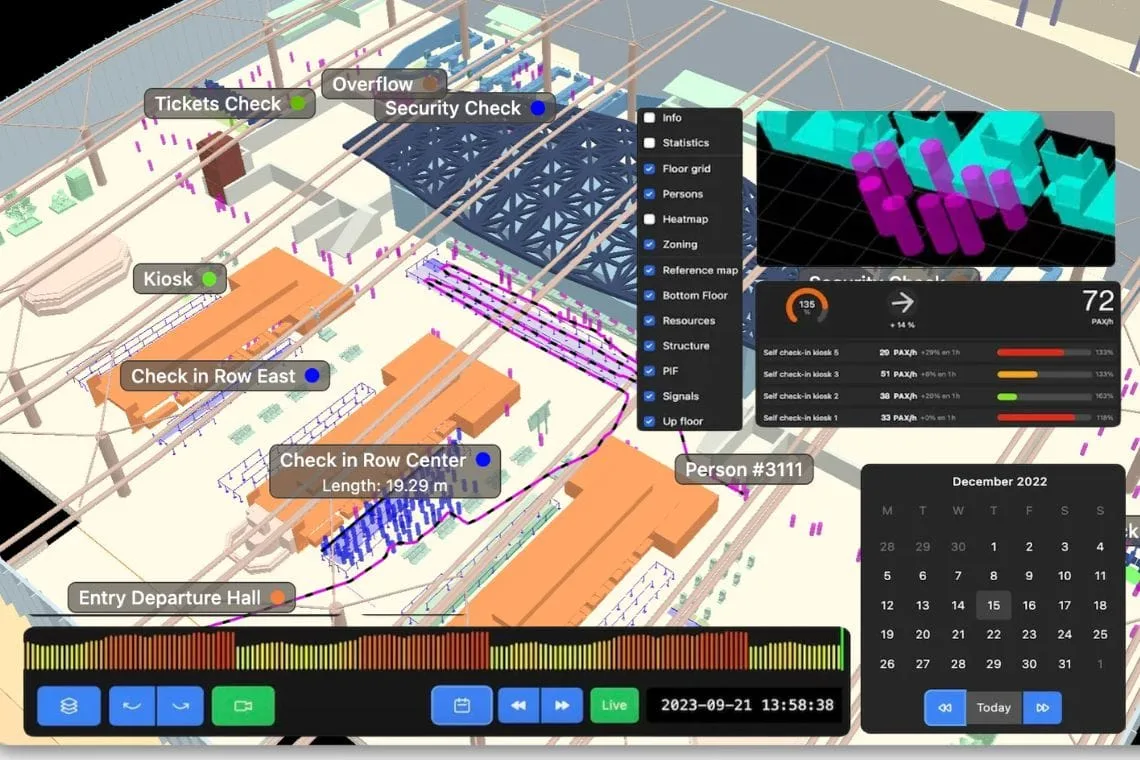
Deployed across Schengen common-use areas, Outsight’s Physical AI solution transforms real-time Lidar data into actionable insights on people flows, queue formation and congestion patterns.

This gives ADR, a Mundys Group company, an end-to-end view of the passenger journey, enabling more agile resource allocation, supporting data-driven process re-engineering, and laying the digital foundation for predictive, Agentic AI-driven airport operations.
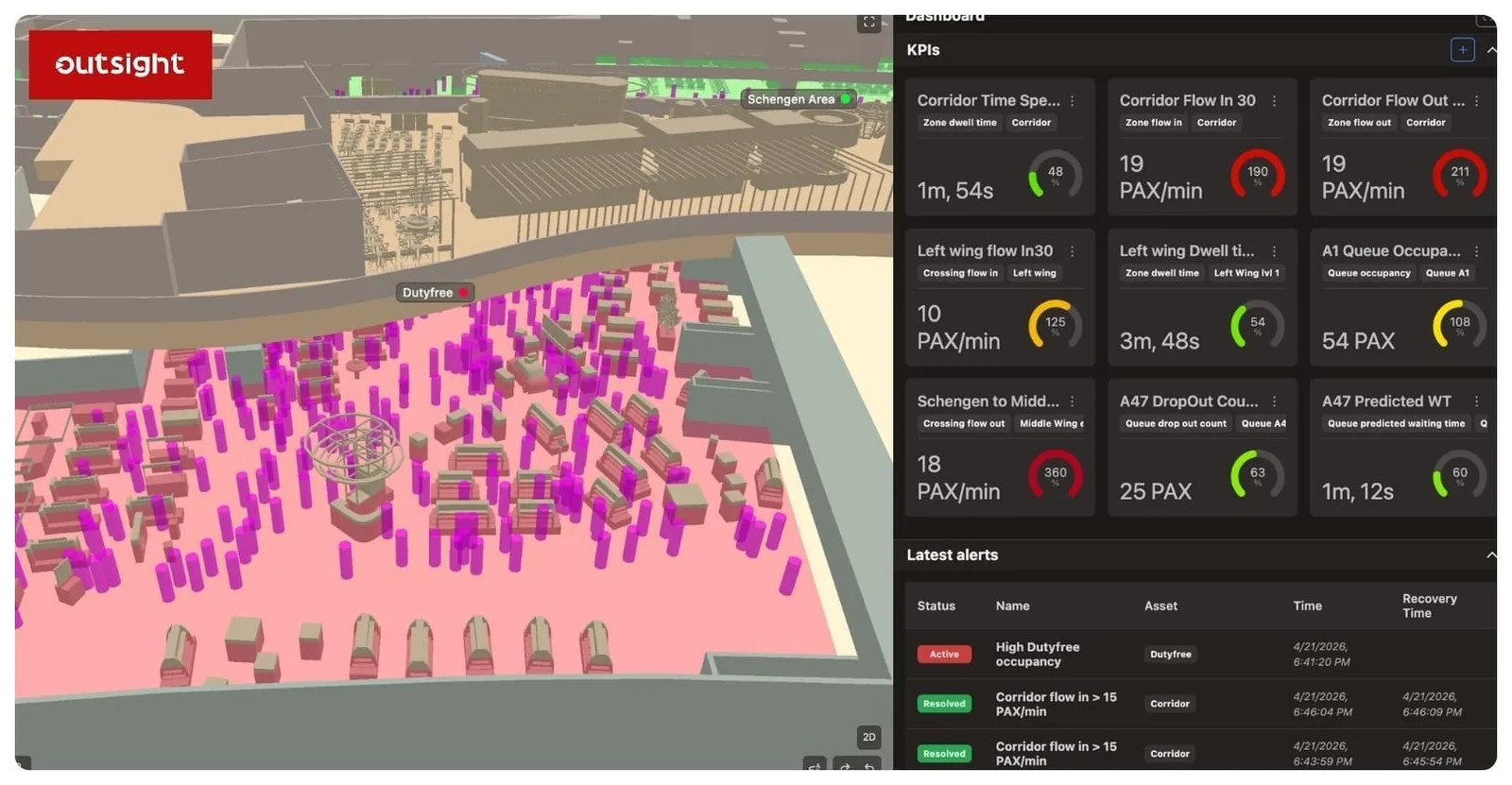
Rome Fiumicino Airport Duty Free Motional Digital Twin

This large-scale deployment signals ADR’s confidence not only in Outsight’s Spatial Intelligence platform, but also in the broader potential of combining LiDAR, advanced analytics and artificial intelligence to shape the next generation of airport management systems.

This major contract will also drive the continued optimization of the technology within the unique complexities of a major international hub like Rome Fiumicino, ranked among the world’s top 10 airports by Skytrax.

What’s a Motional Digital Twin?

How the third generation of Digital Twin technology is transforming the way infrastructure operators understand and optimize the movement of people and vehicles.

Read article →
Emanuele Calà, Senior Vice President Transformation and Technology at Aeroporti di Roma: “At Aeroporti di Roma, we see innovation as a practical lever to continuously improve operations, service quality and the passenger journey. The decision to expand Outsight’s technology across common-use areas within the Schengen zone, reflects our confidence in solutions that can turn airport data into actionable intelligence. Having full visibility over traveler flows in a sensitive environment enables us to act more proactively, optimize processes and support a more seamless and predictable experience for our passengers.

Aeroporti Di Roma selects Outsight’s LiDAR Solution

Rome, Italy – Outsight, the global leader in LiDAR-based Spatial Intelligence, has been chosen to participate in ADR’s highly coveted innovation program, “Runway to the Future,” held at Rome Fiumicino Leonardo da Vinci Airport.

Read article →

Raul Bravo, President and Co-Founder, Outsight “We are proud to deepen our relationship with one of the world’s most innovative airport operators. Moving from a successful pilot to a full-scale deployment is a powerful validation of our Spatial Intelligence platform. By combining Physical AI, LiDAR perception, and real-time analytics, we are helping set a new standard for how major hubs can operate smarter, more responsively and more efficiently.”


Related Articles

AIRPORTS

Aeroporti Di Roma selects Outsight's LiDAR Solution

Rome, Italy – Outsight, the global leader in LiDAR-based Spatial Intelligence, has been chosen to participate in ADR's highly coveted innovation program, "Runway to the Future," held at Rome Fiumicino Leonardo da Vinci Airport.

AIRPORTS

Outsight partners with MWC 2026 for the Airport of the Future exhibition

Outsight will serve as the exhibition’s Spatial AI Technology Partner, providing advanced real-time insights powered by its leading 3D LiDAR-based Spatial Intelligence platform.

Let's connect

Send us a Message

Drop your email and we'll get back to you as soon as possible.

Frequently Asked Questions

  • What is the Schengen common-use area at an airport and why does it matter for passenger tracking?

    Schengen common-use areas are the shared terminal zones, check-in halls, security lanes, and gate areas where multiple airlines share infrastructure rather than operating dedicated facilities. Tracking passenger flow there is particularly complex because densities fluctuate unpredictably across carriers and flight schedules. A single real-time spatial picture covering nearly all of those shared zones gives airport operators a unified view they cannot get from per-airline systems, which is why coverage breadth is the defining metric for a deployment like Rome Fiumicino's. Aeroporti di Roma selected Outsight's SHIFT platform precisely for that reason, expanding the deployment to cover almost all Schengen common-use areas and generating a continuous, anonymous Motional Digital Twin of how passengers, staff, and vehicles move through the terminal at any given moment.

  • How does a pilot deployment at an airport arrivals immigration area translate to a full-terminal rollout?

    An arrivals immigration zone is a controlled chokepoint: bounded, high-density, with measurable dwell and queue outcomes. It is the lowest-risk environment to validate sensor coverage, tracking accuracy, and analytics calibration before committing to wider deployment. Once the operator confirms that queue formation, congestion patterns, and throughput KPIs are being measured reliably there, the same software and sensor architecture scales to broader areas without re-architecting the perception pipeline. This is precisely the path Aeroporti di Roma followed with Outsight, progressing from an initial pilot to a large-scale rollout covering almost all Schengen common-use areas at Rome Fiumicino Airport. The main expansion work shifts to sensor placement planning, site integration, and connecting additional data sources rather than rebuilding the underlying Motional Digital Twin.

  • What does 'agentic AI-driven airport operations' mean in practice?

    Agentic AI refers to AI systems that can autonomously plan and execute multi-step actions, not just surface a dashboard alert, to achieve an operational goal. In an airport context, that means a system that detects a growing queue at a security lane, evaluates available staff and adjacent lane capacity, and then automatically triggers a reallocation workflow without waiting for a supervisor to act. This requires a real-time, structured spatial data feed as input. Outsight's Motional Digital Twin provides exactly that feed, tracking the position and movement of every person and vehicle across a terminal in under 50 milliseconds, in a structured form that AI agents can consume directly. The large-scale deployment at Rome Fiumicino Airport with Aeroporti di Roma illustrates how that foundation enables airport operators to move from passive monitoring toward genuinely autonomous operational responses.

  • What makes Rome Fiumicino a demanding environment for passenger flow technology?

    Rome Fiumicino ranks among the world's top 10 airports by Skytrax and handles a large mix of Schengen, non-Schengen, and domestic traffic across multiple terminals. That multimodal complexity means flow patterns shift with long-haul banks, seasonal tourism peaks, and immigration-control procedures, each creating distinct crowd profiles. Sensors and analytics must handle extreme density variation across the same physical zones at different times of day, which stresses both tracking continuity and the predictive models built on top of it. Aeroporti di Roma selected Outsight to address exactly this challenge, deploying the SHIFT platform across almost all Schengen common-use areas to build a real-time Motional Digital Twin that captures how passengers move through the airport anonymously, without relying on facial recognition or biometric data.

  • Can LiDAR-based flow data support process re-engineering decisions or is it mainly for real-time alerts?

    Both time horizons are valid use cases from the same underlying data. Real-time alerts address live congestion, while the same stream, stored and replayed, provides the historical record operators need to redesign processes. For example, months of queue-formation data can reveal that a specific lane configuration reliably bottlenecks 45 minutes after the peak long-haul bank lands, a pattern invisible in real-time but clear in aggregate. That evidence base grounds re-engineering decisions in measured behavior rather than staff observation or periodic manual counts.

  • How does expanding a LiDAR deployment across an airport affect data privacy compliance?

    Scaling a LiDAR deployment does not increase privacy exposure the way scaling a camera network does. LiDAR sensors capture geometric shape and motion, not faces, skin tone, or license plates. In Outsight's infrastructure-based approach, each tracked person receives an anonymous temporary ID that expires when they leave the monitored area and is never linked to a ticket, passport, or biometric record. This architecture is central to how the SHIFT platform operates at Rome Fiumicino Airport, where Aeroporti di Roma is expanding coverage across almost all Schengen common-use areas. GDPR obligations therefore scale in proportion to data volume and retention policies, not in proportion to the number of identifiable individuals captured, because no identifiable individuals are captured by design.