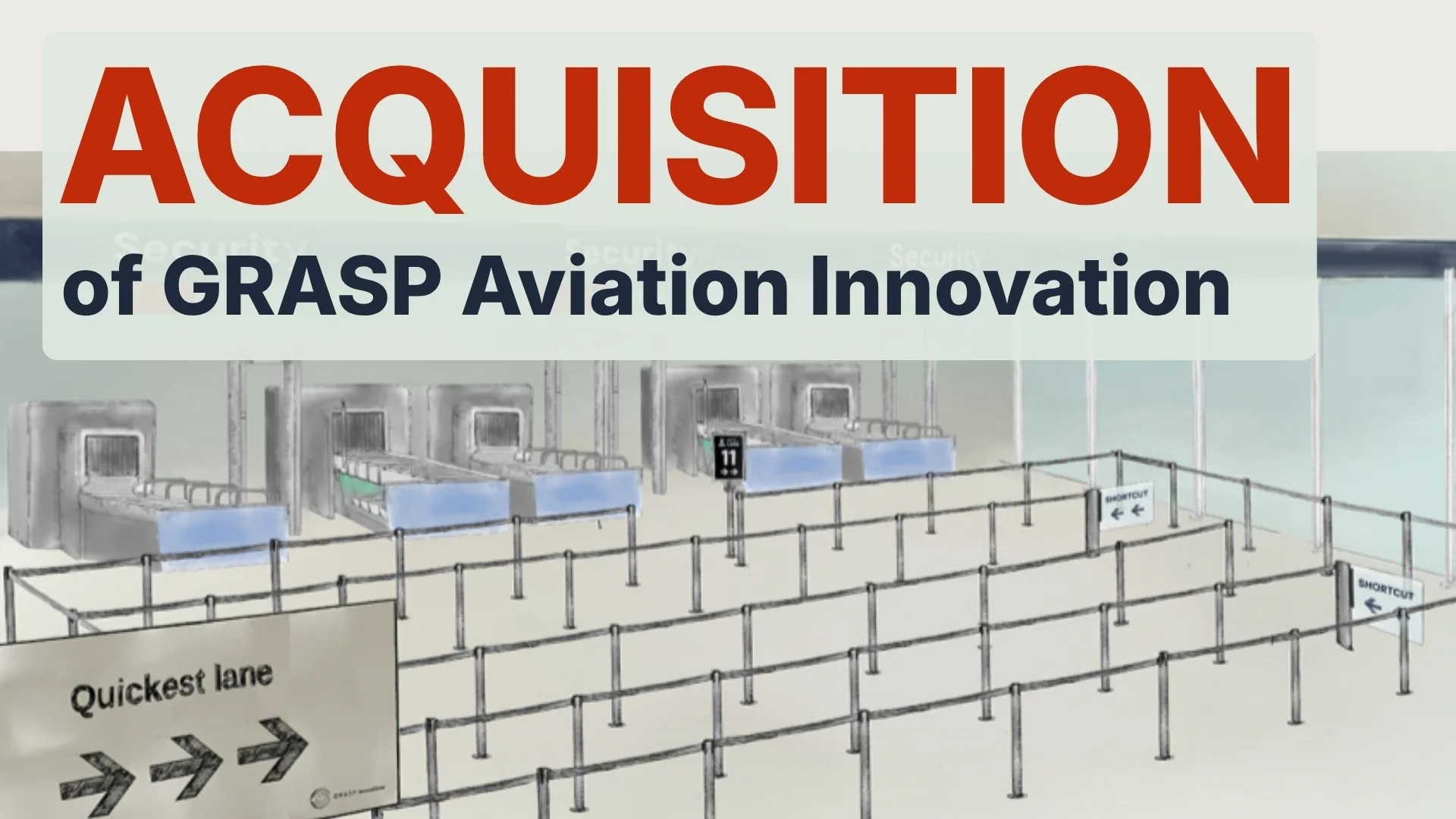
Paris, France, 7 October 2026: Outsight, the pioneer and global leader in Infrastructure-based Physical AI, recently named a leading vendor for Ambient Intelligence in the Gartner Hype Cycle for Physical AI, 2026, today announces the acquisition of GRASP Aviation Innovations.
With this acquisition, Outsight’s Spatial Intelligence now directly drives the airport security checkpoint, guiding every passenger to the best lane and adapting the queue in real time.
Security checkpoints are among the most constrained spaces in any airport. Passenger arrivals change minute by minute, lane performance varies continuously, and every second of waiting shapes the passenger experience.
Algorithms that act on the checkpoint
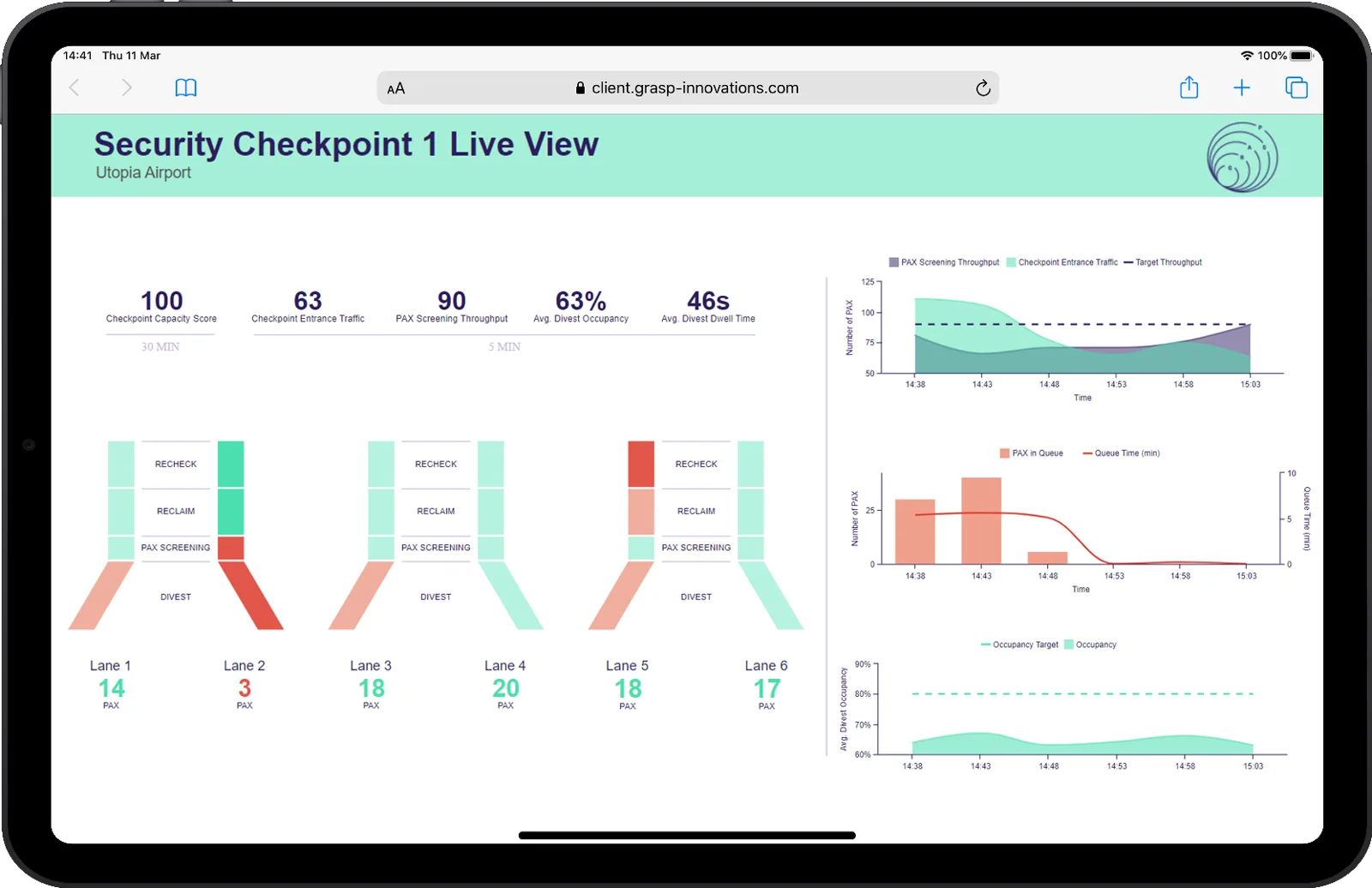
GRASP brings a proven set of algorithms that turn live checkpoint conditions into immediate operational actions.
- Smart queue guidance: the queue is divided into segments whose shape adapts to live conditions, making better use of the available space.
- Passenger guidance: each passenger is directed to the best lane through wayfinding screens and automated gates, with clear instructions displayed in real time.
- Dynamic queue control: automated gates open and close to shorten or lengthen the queue, change its direction, and open or close lanes as demand evolves.
- Load balancing: more passengers are directed to the best-performing lanes, and fewer to lanes under strain.
- Forecast-driven decisions: queue configuration follows the passenger forecast, live arrivals and checkpoint throughput.
Faster, smoother and more efficient checkpoints
For airport operators, the combined solution delivers balanced passenger loads across lanes, with fewer peaks and bottlenecks. Staff previously dedicated to distributing passengers by hand are redeployed to higher-value tasks. Passengers walk less, wait less and move through a checkpoint that continuously adapts to them.
Proven in live operation
GRASP’s technology runs in daily operation at several major European airports. In one of Europe’s leading hubs, for example, it is deployed at scale across nine security lanes.
Outsight’s Spatial Intelligence at the heart of the security checkpoint
GRASP’s algorithms were designed to take queue measurement as a core input.
Historically, GRASP leveraged legacy technologies such as stereovision and lane radars. These are now replaced by Outsight’s Spatial Intelligence Platform leveraging 3D LiDAR data, a far more sophisticated and accurate source, fused with data from sources such as boarding pass information, flight schedules and lane equipment.
Why Outsight uses Lidar
LiDAR combined with Physical AI enables a fundamentally new capability for airports, delivering real-time, airport-wide understanding, powering Motional Digital Twins.
Read article →

The result is one Motional Digital Twin of the entire checkpoint, from the queue entrance to the exit of each lane. It builds on Outsight’s aviation footprint, where more than 280 million annual passengers already travel under the real-time measurement of its Spatial Intelligence Platform.
Outsight crosses 280 million passengers under real-time measurement, from the busiest US hubs to Singapore Changi
More than 280 million annual passengers now travel under real-time measurement by Outsight’s Spatial Intelligence Platform, from the busiest US hubs to Singapore Changi.
Read article →

From Ambient Intelligence to autonomous operations
In July 2026, Gartner named Outsight a leading vendor for Ambient Intelligence in the Gartner Hype Cycle for Physical AI, 2026.
Outsight named in the Gartner Hype Cycle for Physical AI, 2026
Gartner names Outsight a leading vendor in Ambient Intelligence, alongside AWS, Google, Microsoft and Siemens, confirming its lead in infrastructure-based Physical AI.
Read article →

This acquisition extends Outsight’s platform along that exact path. Outsight’s Spatial Intelligence makes the checkpoint sensitive, and GRASP’s algorithms make it responsive and adaptive, second by second.
Gartner states that scalable Physical AI adoption “will depend on edge-heavy, sensor-rich architectures that keep perception, decision making and control close to the operating environment.” With GRASP, Outsight now delivers all three at the security checkpoint.
“Outsight’s Physical AI is built into the infrastructure itself, giving airports a live understanding of every movement across the terminal. With GRASP, that intelligence now acts directly on the checkpoint: which lane each passenger should take, how long the queue should be, when a lane should open,” said Raul Bravo, President Founder, Outsight.
“We built GRASP to give airports a security checkpoint that organizes itself, guiding every passenger to the right lane at the right moment. Our algorithms have proven their value in daily operation at major European airports, and their performance depends directly on the quality of the data that feeds them. Outsight’s Spatial Intelligence brings the most accurate and complete view of the checkpoint available today, together with the global reach and support our customers need,” said Constantijn Viezee, CEO, GRASP Aviation Innovations.
A recognized leader in aviation
This acquisition strengthens a position already recognized across the industry. Outsight has received the Terminal Excellence Innovation Award at Inter Airport Europe, the Airport Technology Award, the CES Best of Innovation Award and the Frost & Sullivan Global Technology Innovation Leadership Award, and has been named in Sifted’s B2B SaaS Rising 100.
Outsight Wins the Terminal Excellence Innovation Award at Inter Airport Europe 2025
The award highlights how our cutting-edge 3D LiDAR-based Spatial Intelligence solutions have contributed to airport innovation across Europe and beyond.
Read article →

Airports such as Singapore Changi, Rome Fiumicino and Paris Airports, together with some of the largest airports in North and South America, rely every day on Outsight’s security-certified platform (ISO 27001, SOC 2, TISAX, ENS and BASt).
Outsight Attains ISO 27001 Certification
We are thrilled to announce the achievement of ISO 27001 Certification, marking a commitment to top-tier information security.
Read article →
Availability
The combined solution is available today to airports everywhere in the world, supported by Outsight’s offices in Paris, San Francisco, Singapore and Hong Kong and its Enterprise-grade Technical Support team working 24 hours a day in a follow-the-sun approach.
The acquisition covers GRASP’s aviation business. All of GRASP’s non-aviation activities continue as Reassurance Technologies.
Media contact
Julie Bourdinot, Outsight julie.bourdinot@outsight.tech www.outsight.ai