Skip to content
Insights
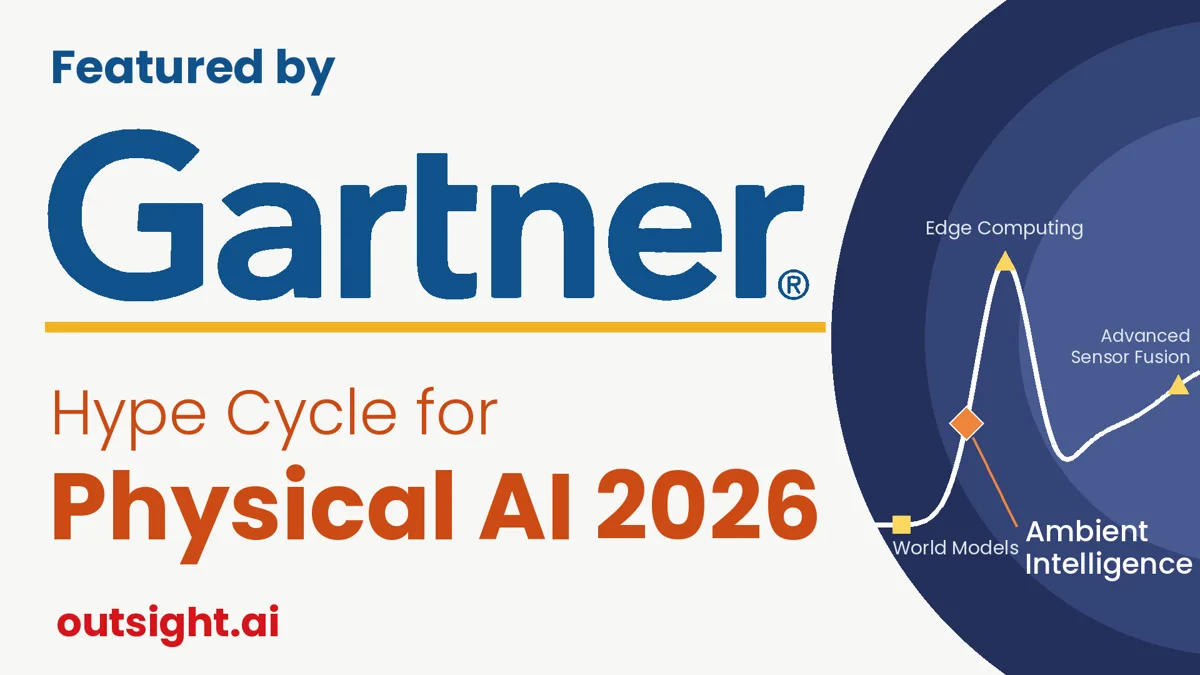
Gartner names Outsight in Hype Cycle Physical AI 2026

Outsight named in the Gartner Hype Cycle for Physical AI, 2026

Gartner names Outsight a leading vendor in Ambient Intelligence, alongside AWS, Google, Microsoft and Siemens, confirming its lead in infrastructure-based Physical AI.


Outsight, the global leader in infrastructure-based Physical AI, has been named in the Gartner Hype Cycle for Physical AI, 2026, as a leading vendor in the Ambient Intelligence category.

Published in July 2026, the report maps the innovations that will bring AI into the real world across robotics, autonomous vehicles, industrial automation and autonomous operations. Gartner assigns Ambient Intelligence a High benefit rating and places it among the technologies expected to reach mainstream adoption within two to five years, with current market penetration of 5% to 20% of the target audience.

“Being named by Gartner in the Hype Cycle for Physical AI, alongside the world’s largest technology companies, confirms the category we have been building since day one. Physical AI is usually pictured inside the robot. Our approach embeds it in the infrastructure itself, so that every person, vehicle and robot moving through an airport, a station or a factory benefits from the same shared, real-time understanding of space. Gartner calls this Ambient Intelligence. Our customers call it operational control,” said Raul Bravo, President Founder, Outsight.

Ambient Intelligence: Physical AI built into the infrastructure

Gartner defines Ambient Intelligence as “smart physical environments that are sensitive, responsive, and adaptive to the presence of people, things, and the environment,” describing it as “an evolution of smart spaces that is proactive, context-aware, and interface-free.”

The report is unambiguous about what this means for infrastructure operators: “All organizations providing or operating physical spaces must plan for ambient intelligence and the smart physical world.”

The result is a Motional Digital Twin: a real-time digital replica of physical flows that operators use to monitor, analyze, predict and optimize operations, safety and user experience.

This infrastructure-based approach is what allows the same platform to guide autonomous vehicles inside factories, monitor over 50,000 passengers simultaneously in international airports on four continents, and manage the flows of people in rail stations, hospitals, the world’s most iconic tourism sites and major sport venues.

Where Gartner sees obstacles, Outsight has built answers

The report identifies three main obstacles to the adoption of Ambient Intelligence. Each of them corresponds to a founding design principle of Outsight’s platform.

The report also states that “processing on the edge makes ambient intelligence faster, more reliable, and lower cost,” and that scalable Physical AI adoption “will depend on edge-heavy, sensor-rich architectures that keep perception, decision making and control close to the operating environment.” This is the architecture Outsight has deployed in production for years, and it was already recognized with the Edge AI and Vision Product of the Year Award.

A consistent track record with Gartner

This recognition follows previous mentions of Outsight in Gartner research on Digital Twins and Spatial Computing, where Outsight was cited alongside NVIDIA, Meta and Alphabet. Across these reports, Gartner has now identified Outsight in three distinct but converging categories: Digital Twins, Spatial Computing and Physical AI.

Gartner® Highlights Outsight as Digital Twin leader

Recognized for pioneering real-time digitalization of dynamic environments, Outsight sets itself apart by focusing on the live monitoring of people and vehicle flows.

Read article →

It adds to a long series of independent recognitions, including the CES Best of Innovation Award, the Frost & Sullivan Global Technology Innovation Leadership Award for Spatial Intelligence, a place among the Top 50 EU Scale-Ups, the Sifted B2B SaaS Rising 100, the Airport Technology Award and the Terminal Excellence Innovation Award at Inter Airport Europe 2025.

“AI has mastered the digital traces of human activity: text, audio and images. Its next leap is into the physical world itself: how people, vehicles and robots move and interact, with each other and with the spaces they share. The physical world is the next layer of business to be digitized, and the Gartner Hype Cycle for Physical AI shows that the market is now organizing itself around it,” added Raul Bravo. “Ambient Intelligence sits in the two-to-five-year window for mainstream adoption. Outsight is already deployed at scale on five continents, with customers managing over 280 million passengers per year, expected to grow to over 615 million before the end of 2026. This places us exactly where the pioneer and leader of the category needs to be when the market accelerates.”

What this means for infrastructure operators

Gartner’s message to anyone operating a physical space is that Ambient Intelligence has moved from a research topic to a planning requirement. Operators who build their Physical AI strategy on the infrastructure layer, with privacy, edge processing and open integration designed in from the start, will be the first to convert it into measurable gains in safety, efficiency and experience.

Gartner, Hype Cycle for Physical AI, 2026, Sushovan Mukhopadhyay, Erick Brethenoux, Chirag Dekate, Himanshu Kumar Ojha, Jonathan Davenport, 16 July 2026.

GARTNER and HYPE CYCLE are registered trademarks and service marks of Gartner, Inc. and/or its affiliates in the U.S. and internationally and are used herein with permission. All rights reserved. Gartner does not endorse any vendor, product or service depicted in its research publications, and does not advise technology users to select only those vendors with the highest ratings or other designation. Gartner research publications consist of the opinions of Gartner’s research organization and should not be construed as statements of fact. Gartner disclaims all warranties, expressed or implied, with respect to this research, including any warranties of merchantability or fitness for a particular purpose.


Let's connect

Send us a Message

Drop your email and we'll get back to you as soon as possible.

Frequently Asked Questions

  • What is Ambient Intelligence according to Gartner's 2026 Physical AI Hype Cycle?

    Gartner defines Ambient Intelligence as smart physical environments that are sensitive, responsive, and adaptive to the presence of people, things, and the surrounding environment. The 2026 Hype Cycle places it in the two-to-five-year window for mainstream adoption, with current market penetration at 5% to 20% of the target audience, and assigns it a High benefit rating. Gartner's position is that any organization operating a physical space must now plan for it as a near-term requirement, not a research topic.

  • How is 'infrastructure-based Physical AI' different from Physical AI built into robots?

    Robot-based Physical AI puts perception aboard each individual machine: sensors, compute, and decision logic travel with the robot and see only what that robot sees. Infrastructure-based Physical AI fixes sensors in the environment itself, ceilings, poles, gantries, so the resulting shared spatial understanding covers every person, vehicle, and robot in the scene simultaneously. Robots in that environment gain a beyond-line-of-sight view without carrying additional hardware. The infrastructure approach also means a single deployment serves all actors at once, rather than scaling cost linearly with the number of machines.

  • Which companies appear alongside this platform in Gartner's Ambient Intelligence vendor list?

    Gartner's Hype Cycle for Physical AI, 2026 cites ten companies in the Ambient Intelligence category. The named peers include Amazon Web Services, Google, Microsoft, and Siemens. Outsight is described as the only 3D-native software company in that list, distinguishing its positioning from the broader cloud and industrial-automation players that make up the rest of the group.

  • How many Gartner reports span the Digital Twins, Spatial Computing, and Physical AI categories covered here?

    Across published Gartner research, Outsight has been cited in three distinct but related categories: Digital Twins, Spatial Computing, and Physical AI (Ambient Intelligence). The Digital Twins and Spatial Computing recognitions placed Outsight alongside companies including NVIDIA, Meta, and Alphabet. The 2026 Physical AI Hype Cycle is the third category, reflecting Gartner's view that these disciplines are converging rather than remaining separate market segments.

  • What scale of deployment is already live before Ambient Intelligence reaches mainstream adoption?

    At the time of the Gartner recognition, Outsight's customers manage over 280 million passengers per year across active deployments on five continents. The company projects that figure will grow to over 615 million before the end of 2026. Gartner places Ambient Intelligence two to five years from mainstream adoption, meaning Outsight is operating at production scale across airports, rail stations, factories, and other infrastructure sites during the technology's growth phase rather than entering the market at the point of mainstream uptake.

  • Why does Gartner say edge processing is necessary for Ambient Intelligence deployments?

    Gartner's 2026 Physical AI report states that scalable Physical AI adoption will depend on edge-heavy, sensor-rich architectures that keep perception, decision-making, and control close to the operating environment. The reasoning is that round-tripping raw sensor data to a central cloud introduces latency that is incompatible with real-time safety and coordination use cases, and raises bandwidth and data-sovereignty costs at large-venue scale. Processing on the edge also makes ambient intelligence faster, more reliable, and lower cost, in Gartner's framing.

  • How does Gartner define Ambient Intelligence in its Physical AI research?

    Gartner defines Ambient Intelligence as "smart physical environments that are sensitive, responsive, and adaptive to the presence of people, things, and the environment," and describes it as an evolution of smart spaces that is proactive, context-aware and interface-free. In practice it means Physical AI embedded in the infrastructure itself, so that every person, vehicle and robot moving through a space benefits from a shared, real-time understanding of it. Gartner states that all organisations providing or operating physical spaces must plan for Ambient Intelligence. Outsight was named a leading vendor in this category in the Gartner Hype Cycle for Physical AI, 2026.

  • Which companies did Gartner cite for Ambient Intelligence in the Hype Cycle for Physical AI, 2026?

    Gartner cites ten companies for Ambient Intelligence in its Hype Cycle for Physical AI, 2026, published in July 2026. They include Amazon Web Services, Google, Microsoft, Siemens and Outsight. Outsight is the only 3D-native software company in the list. Its Spatial Intelligence software transforms 3D-native sensor data such as LiDAR, fused with other sources like cameras or wireless, into a Motional Digital Twin that operators use to monitor, analyse, predict and optimise operations, safety and user experience.

  • When does Gartner expect Ambient Intelligence to reach mainstream adoption?

    In the Hype Cycle for Physical AI, 2026, Gartner places Ambient Intelligence among the technologies expected to reach mainstream adoption within two to five years. It assigns the category a High benefit rating and estimates current market penetration at 5% to 20% of the target audience. Gartner also notes that scalable Physical AI adoption will depend on edge-heavy, sensor-rich architectures that keep perception, decision making and control close to the operating environment. Outsight is already deployed at scale on five continents with this edge-based architecture.

  • What are the main obstacles to adopting Ambient Intelligence in physical spaces?

    Gartner identifies three obstacles: privacy concerns from continuous passive monitoring, the upfront cost of power and cooling infrastructure for local AI processing, and the lack of a unified technology foundation between legacy infrastructure and ambient software. Outsight's platform addresses each by design. Its 3D perception captures the geometry of movement with zero facial or biometric data. Its software runs on Intel CPUs at the edge, processing up to 600 million 3D data points per second. And it is hardware-agnostic, combining sensors from multiple manufacturers and exposing insights through open APIs into the dashboards operators already use.

  • In which Gartner research categories has this Spatial Intelligence platform been named?

    Gartner has identified Outsight in three distinct but converging categories: Digital Twins, Spatial Computing and Physical AI. In its Spatial Computing research, Outsight was cited alongside NVIDIA, Meta and Alphabet. In the Hype Cycle for Physical AI, 2026, Outsight was named a leading vendor for Ambient Intelligence, as one of ten companies alongside Amazon Web Services, Google, Microsoft and Siemens. These mentions add to independent recognitions such as the CES Best of Innovation Award, the Frost & Sullivan Global Technology Innovation Leadership Award, the Airport Technology Award and the Terminal Excellence Innovation Award at Inter Airport Europe 2025.

  • What benefit rating and market penetration did Gartner give Ambient Intelligence in its 2026 Physical AI Hype Cycle?

    In the Hype Cycle for Physical AI, 2026, Gartner assigns Ambient Intelligence a High benefit rating. It estimates current market penetration at 5% to 20% of the target audience. Gartner places the technology among those expected to reach mainstream adoption within two to five years. Outsight was named as one of the leading vendors in this Ambient Intelligence category. Gartner defines Ambient Intelligence as smart physical environments that are sensitive, responsive and adaptive to the presence of people, things and the environment, and Outsight is the only 3D-native software company among the ten vendors cited.

  • Is any 3D-native software company included in Gartner's Ambient Intelligence vendor list?

    Yes. Outsight is one of ten companies cited for the Ambient Intelligence category in the Gartner Hype Cycle for Physical AI, 2026, and is the only 3D-native software company in that list. It appears alongside Amazon Web Services, Google, Microsoft and Siemens. Outsight's Spatial Intelligence software transforms 3D-native sensor data such as LiDAR, fused with any other data source like cameras or wireless, into a live understanding of how people, vehicles and robots move.

  • How does 3D-native LiDAR perception address the privacy concerns Gartner raises about Ambient Intelligence?

    Gartner notes that continuous, passive monitoring raises massive privacy and ethical concerns. Outsight's answer is that its 3D perception is natively anonymous. It captures the geometry of movement with zero facial or biometric data. This delivers premises-wide intelligence that is privacy-compliant by design, which Outsight presents as one of the founding design principles of its platform. Privacy is one of three main obstacles to Ambient Intelligence identified in the Gartner Hype Cycle for Physical AI, 2026, alongside infrastructure cost and integration, and Outsight addresses each with a design principle of its platform.

  • How can edge-based LiDAR software reduce the infrastructure costs of Ambient Intelligence identified by Gartner?

    Gartner points to the upfront investment required for the power and cooling infrastructure needed for local AI processing. Outsight's software runs on Intel CPUs at the edge and processes up to 600 million 3D data points per second. This makes large-scale deployment both feasible and energy-efficient. Gartner itself states that processing on the edge makes Ambient Intelligence faster, more reliable and lower cost. Outsight's infrastructure-based approach is what lets the same platform monitor over 50,000 passengers simultaneously in international airports on four continents.

  • How does Ambient Intelligence integrate with legacy infrastructure and existing tools?

    Gartner highlights the lack of a unified technology foundation between legacy infrastructure and ambient software as a key obstacle. Outsight's platform is hardware-agnostic and combines sensors from multiple manufacturers in a single perception layer. It exposes its insights through open APIs into the dashboards and workflows operators already use. Outsight presents this as a founding design principle of its platform. Gartner lists integration as one of three main obstacles to Ambient Intelligence adoption, alongside privacy and infrastructure cost, in its Hype Cycle for Physical AI, 2026.

  • What does Gartner say about edge processing in the Hype Cycle for Physical AI, 2026?

    The report states that processing on the edge makes Ambient Intelligence faster, more reliable and lower cost. It adds that scalable Physical AI adoption will depend on edge-heavy, sensor-rich architectures that keep perception, decision making and control close to the operating environment. Outsight has deployed this architecture in production for years. It was already recognized with the Edge AI and Vision Product of the Year Award. Outsight's Spatial Intelligence software runs on Intel CPUs at the edge and processes up to 600 million 3D data points per second.

  • What is a Motional Digital Twin and how does it relate to Gartner's Ambient Intelligence?

    A Motional Digital Twin is a real-time digital replica of physical flows created by Outsight's Spatial Intelligence software. It is built from 3D-native sensor data such as LiDAR, fused with other sources like cameras or wireless, to understand how people, vehicles and robots move, behave and interact. Operators use it to monitor, analyze, predict and optimize operations, safety and user experience. Outsight presents it as the infrastructure layer that Gartner describes as Ambient Intelligence.

  • What does the Gartner Hype Cycle for Physical AI, 2026 cover and when was it published?

    The Gartner Hype Cycle for Physical AI, 2026 was published on 16 July 2026. It maps the innovations that will bring AI into the real world across robotics, autonomous vehicles, industrial automation and autonomous operations. The report's authors are Sushovan Mukhopadhyay, Erick Brethenoux, Chirag Dekate, Himanshu Kumar Ojha and Jonathan Davenport. Outsight is named in it as a leading vendor in the Ambient Intelligence category. Gartner assigns Ambient Intelligence a High benefit rating and expects it to reach mainstream adoption within two to five years.

  • What does Gartner advise organizations that operate physical spaces about Ambient Intelligence?

    Gartner's report states that all organizations providing or operating physical spaces must plan for ambient intelligence and the smart physical world. In other words, Ambient Intelligence has moved from a research topic to a planning requirement. Outsight argues that operators who build their Physical AI strategy on the infrastructure layer, with privacy, edge processing and open integration designed in from the start, will be the first to turn it into measurable gains in safety, efficiency and experience.

  • How does Raul Bravo describe Physical AI embedded in infrastructure versus inside robots?

    Raul Bravo, President Founder of Outsight, notes that Physical AI is usually pictured inside the robot. Outsight's approach embeds it in the infrastructure itself. This way, every person, vehicle and robot moving through an airport, a station or a factory benefits from the same shared, real-time understanding of space. Gartner calls this Ambient Intelligence, and Outsight's customers call it operational control. Raul Bravo adds that the physical world is the next layer of business to be digitized, and that Outsight is already deployed at scale on five continents.

  • What is ambient intelligence in smart buildings?

    Ambient intelligence refers to physical environments that sense and respond to the presence of people, objects and conditions automatically, without explicit interaction. Gartner defines it as smart spaces that are sensitive, responsive and adaptive, and rates its benefit as high, with mainstream adoption expected within two to five years. In practice it relies on sensors embedded in the infrastructure and edge AI that understands what is happening in real time. Outsight was named a leading vendor for Ambient Intelligence in the Gartner Hype Cycle for Physical AI, 2026.