Skip to content
Insights
Gartner® Recognizes Outsight as a Key Player in Spatial Computing

Gartner® Recognizes Outsight as a Key Player in Spatial Computing

In its latest Emerging Tech Impact Radar: Computer Vision report, Gartner identifies Outsight as a key vendor in Spatial Computing, alongside major technology players such as Nvidia, Meta, Alphabet, and Matterport.


Outsight has once again been recognized by Gartner, the world’s leading technology research and advisory firm.

This follows our previous inclusion in Gartner’s analysis of Digital Twin technology, where Outsight was highlighted for its role in advancing real-time Spatial Intelligence for critical infrastructure:

Gartner® Highlights Outsight as Digital Twin leader

Recognized for pioneering real-time digitalization of dynamic environments, Outsight sets itself apart by focusing on the live monitoring of people and vehicle flows.

Read article →

The latest recognition further validates that Spatial AI is no longer a future vision but a present-day reality, already being deployed at scale across industries such as transportation, smart cities, and industrial logistics.
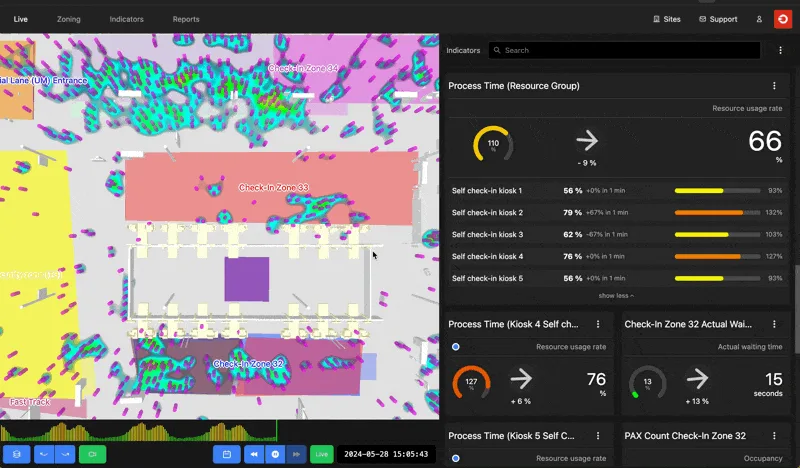
Spatial Intelligence at scale in large infrastructures.

Spatial Computing is emerging as a fundamental technology for enterprises looking to digitize and optimize physical operations.

According to Gartner, “Spatial Computing will redefine how businesses interact with real-world environments, offering unparalleled precision in people and vehicle flow analysis.”

The ability to turn real-world motion into actionable data is no longer an experimental concept; it is an operational necessity for major infrastructure operators worldwide.

Spatial Computing and the Shift to Real-Time Infrastructure Intelligence

Spatial Computing is transforming how organizations monitor and optimize large-scale physical environments.

By integrating advanced lidar sensors, AI-powered analytics, and real-time spatial tracking, businesses can move beyond static video surveillance or traditional monitoring methods toward continuous, automated intelligence about physical movement and resource utilization.
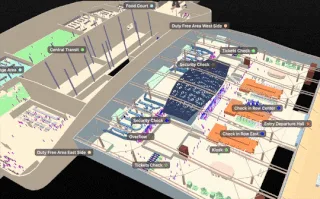
A Live Digital Twin is a game-changer technology for Large Infrastructures like airports.

Gartner predicts that “80% of 3D imaging sensors for smart spaces will use LiDAR or mmWave radar as the primary vision imaging sensor by 2030.”

Our hardware-agnostic approach allows our customers to always use the optimum combination of sensors from the right manufacturers for their context:

Not All LiDAR Sensors Are Equal: Key Differences Explained

This article explores LiDAR differences and why customers use multiple vendors to meet their needs.

Read article →

The shift towards 3D Computer Vision (or Spatial AI) is already well underway, as LiDAR-based analytics provide a level of depth perception and spatial awareness that cameras and Wi-Fi-based tracking solutions cannot match.

Introducing 3rd Gen People Counting Technology

Mirroring the technological evolution seen across various industries, People Tracking and Counting Technologies have already entered their third generation.

Read article →
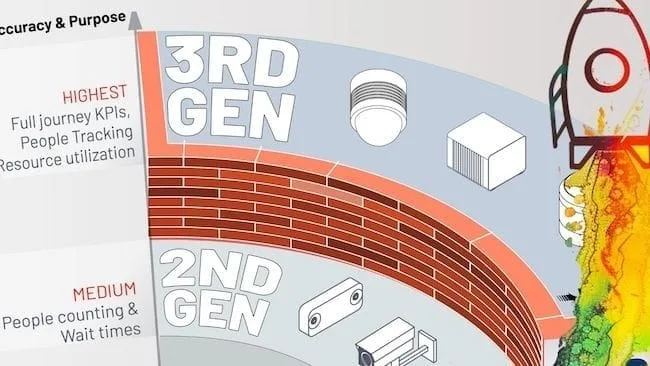
While many companies are becoming increasingly aware of the limitations of legacy 2D Camera technology and start to explore how to leverage Spatial Computing, Outsight has already made it a reality: our LiDAR-powered Spatial AI platform is delivering real-time digital intelligence for the physical world, helping infrastructure operators optimize security, efficiency, and customer experience at scale.

LiDAR Manages Increased Airport Traffic

See how and why Airports are increasingly using LiDAR-based software solutions to tackle their biggest challenges, leveraging the unique value of Spatial Intelligence.

Read article →

Why Gartner’s Recognition Matters for the Industry

Gartner’s acknowledgment of Outsight in the Spatial Computing category is a strong indication that the technology is rapidly moving toward widespread adoption.

The report highlights that “enterprise video will increasingly be processed at the edge, reducing latency and unlocking real-time operational intelligence.”

This aligns with Outsight’s approach of enabling on-premise, real-time analysis of physical flows without the need for cloud-dependent heavy processing and was recognized as soon as 2023 by the Edge AI Vision Alliance Product of the Year award:

Outsight Wins 2023 Edge AI and Vision Product Award

We’re thrilled to announce that the 6th generation of our 3D LiDAR processing software, has been awarded the 2023 Edge AI and Vision Product of the Year!

Read article →

By digitizing people and vehicle movement with continuous tracking and real-time analytics, businesses can make data-driven decisions faster, reducing inefficiencies and enhancing safety.

This capability is particularly relevant for industries where large-scale movement of people and goods is critical, such as airports, logistics hubs, and smart cities.

Outsight leadership in the space was recently highlighted by the Airport Technology Innovation award:

Outsight Earns 2024 Airport Technology Award

Outsight’s groundbreaking Spatial AI Software Platform, Shift, has received the 2024 Airport Technology Excellence Awards, an event aiming to celebrate the best and greatest achievements in the aviation industry.

Read article →

Outsight’s Role in Leading the Spatial Computing Revolution

Unlike traditional solutions that rely on cameras, Wi-Fi tracking, or manual people counting, Outsight’s LiDAR-based Spatial AI technology provides:

Real-time, premises-wide tracking of people and vehicles, enabling continuous digital twin creation for infrastructure operators.

Natively anonymous data, ensuring privacy-compliant tracking without facial recognition or intrusive surveillance.

Anonymous vs. Anonymized : Learn the Difference

Understanding Anonymity in Sensor Data: discover the inherent privacy characteristics of each type of Sensor data and the potential risks associated with anonymizing sensitive information

Read article →

Processing efficiency, with AI models running on CPUs instead of power-intensive GPUs, making large-scale deployment feasible and cost-effective.

Enterprise-grade analytics, delivering actionable insights on crowd movement, security, and operational optimization.

These advantages are why leading global infrastructures are already implementing Outsight’s technology at scale, proving that Spatial Computing is not a distant future but a present-day necessity.

The Future of Infrastructure Intelligence Starts Today

Gartner’s latest recognition of Outsight highlights the growing importance of Spatial Computing in shaping the future of infrastructure intelligence.

The ability to digitize, track, and analyze physical movement in real-time has become a critical advantage for forward-thinking organizations looking to optimize operations, enhance security, and improve efficiency at scale.

Enterprises that act now will be at the forefront of AI-driven infrastructure optimization, privacy-compliant tracking, and real-time Digital Twin intelligence.

To learn more about how Outsight’s Spatial AI can transform your operations, explore our solutions today.

Related Articles

TECHNOLOGY

Outsight enters the Intel® Partner Alliance as a Gold Member

Together with Intel, we are set to deliver unprecedented solutions in the emerging field of Spatial AI.

AIRPORTS

Why Now? The 7 Key Drivers Accelerating LiDAR Adoption in Airports

Discover the 7 key drivers making LiDAR-based Spatial Intelligence a reality in airports, real-time, anonymous, and ready for global deployment.

Let's connect

Send us a Message

Drop your email and we'll get back to you as soon as possible.

Frequently Asked Questions

  • What is Spatial Computing and how is it different from traditional video analytics?

    Spatial Computing processes 3D sensor data to track the position, trajectory, and behavior of every person and vehicle across a physical site in real time. Traditional video analytics works on 2D image frames, which means it lacks native depth information and struggles in dense or occluded environments. The practical gap shows up in scale: a 2D camera system counts pixels, while a Spatial Computing system tracks discrete entities with centimeter-level spatial precision, assigns each a persistent anonymous ID, and predicts where bottlenecks will form before they occur. Gartner identifies Outsight as a key vendor in this space, and its SHIFT platform applies exactly this approach through infrastructure-based LiDAR deployments at sites such as Dallas Fort Worth Airport and BMW factories, processing roughly 4.7 billion 3D objects per year across five continents.

  • Why does Gartner treat LiDAR as the primary sensor for smart-space 3D imaging?

    Gartner projects that 80% of 3D imaging sensors for smart spaces will use LiDAR or mmWave radar as the primary vision imaging sensor by 2030. The underlying reason is physics: LiDAR emits laser pulses and measures return times, producing accurate depth data in any lighting condition without recording faces or license plates. mmWave radar shares the privacy property but delivers far coarser spatial resolution. For use cases that require tracking individual people through crowded terminals or intersections with centimeter precision, LiDAR is the only sensor that currently meets both the accuracy and the privacy requirements simultaneously. Outsight's SHIFT platform is built around precisely this combination, processing LiDAR point clouds through a sub-50ms pipeline to generate anonymous 3D motion data across deployments such as Dallas Fort Worth Airport and SNCF train stations in France.

  • What does it mean for Spatial AI to run on CPUs instead of GPUs at the edge?

    Running perception and tracking workloads on CPUs rather than GPUs changes the economics of large-scale deployment substantially. GPU-based inference requires specialized hardware that draws significantly more power, generates more heat, and costs more per node. A CPU-capable pipeline can run on standard edge servers or industrial PCs already present at most infrastructure sites, reducing per-sensor capital expenditure and eliminating the need for dedicated GPU clusters in each terminal or building. Outsight's SHIFT platform is built around this principle: its sub-50ms end-to-end pipeline processes 3D LiDAR data on CPU-based edge hardware, which is a key reason infrastructure operators can scale to dozens of sensors across a large facility, as seen in deployments like Dallas Fort Worth, without a proportional jump in hardware budget.

  • Which other companies appear alongside Outsight in Gartner's Spatial Computing vendor landscape?

    The Gartner Emerging Tech Impact Radar: Computer Vision report places Outsight in the Spatial Computing category alongside Nvidia, Meta, Alphabet, and Matterport. That peer set spans semiconductor platforms, consumer hardware, hyperscale cloud, and static 3D mapping software. Outsight occupies a distinct position among them: it is the only company in that list focused specifically on real-time, anonymous tracking of people and vehicle flows through fixed infrastructure, rather than on rendering, device ecosystems, or photogrammetric site capture. That focus is embodied in the Motional Digital Twin, a live 3D replica of movement across a physical site, delivered through the SHIFT platform and deployed across airports, train stations, factories, and smart-city intersections on five continents.

  • How does on-premise edge processing change data sovereignty for infrastructure operators?

    When the full perception and analytics pipeline runs on hardware located inside the operator's own facility, raw 3D point-cloud data never leaves the site network. Only structured outputs (entity counts, dwell times, queue depths, anomaly alerts) need to travel to dashboards or external systems. Outsight's SHIFT platform is built on this principle: LiDAR sensors process and discard raw spatial data at the edge, and the Motional Digital Twin exposes only anonymous, structured telemetry to downstream systems. This matters for operators in regulated sectors: airports handling passenger data under aviation-security frameworks, hospitals under healthcare privacy rules, and datacenters under cyber-physical security mandates can all satisfy data-residency requirements without architectural exemptions, because the sensitive raw data is processed and discarded locally.

  • What distinguishes a Spatial Computing recognition from a Digital Twin recognition in analyst reports?

    Analyst firms treat Digital Twins as a data-architecture category: the question is whether an organization has a persistent, synchronized model of an asset or process. Spatial Computing is evaluated as a sensing-and-interaction category: the question is whether the technology can perceive, understand, and act on physical environments in real time. A system can build a digital twin without qualifying as Spatial Computing (a static BIM model is one example), and early Spatial Computing deployments have operated without a formal twin layer. Outsight's appearance in both Gartner categories reflects that its SHIFT platform bridges the two disciplines: it derives a live Motional Digital Twin directly from real-time spatial perception, using infrastructure-mounted LiDAR rather than device-worn sensors, producing a continuous 3D model of how people, vehicles, and robots move through a physical site.