
Skip to content
Insights
Airport Technology Award for Innovation 2024 to Outsight

Outsight Wins the 2024 Airport Technology Excellence Award

Outsight’s groundbreaking Spatial AI Software Platform, Shift, has received the 2024 Airport Technology Excellence Awards, an event aiming to celebrate the best and greatest achievements in the aviation industry.


This award recognises Outsight’s role in pushing the boundaries of Spatial Intelligence and 3D perception technologies on the global stage, with its Spatial AI and LiDAR technology solutions being deployed across four continents, and cements its position as the leading innovator in the Spatial Intelligence domain.
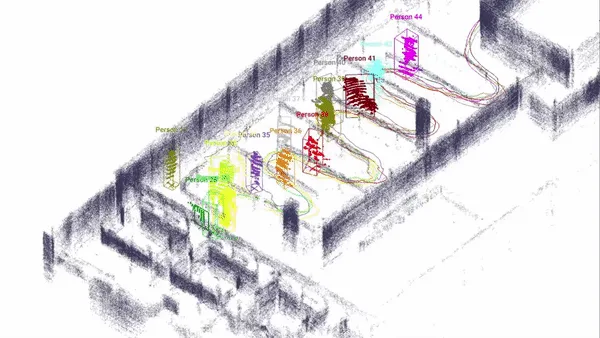
Passenger flow tracking for passport control

Shift’s ability to integrate seamlessly with any LiDAR sensor and manufacturer makes it a versatile tool when working on projects requiring accurate and anonymous tracking of people in the terminals or vehicles in curbside, parking or airside.

Key Advantages of LiDAR for Airports

LiDAR technology and Software is shaping a new wave of operational excellence, passenger experience and safety for airports of all sizes.

Read article →

Based on 3D LiDAR software, Shift transforms raw LiDAR Data from a combination of different manufacturers into actionable insights, analyzing positions and movements of people, objects, and vehicles with laser precision.

This helps airports manage and monitor passenger flow and vehicle traffic, unlocking unparalleled capabilities in spatial analytics.
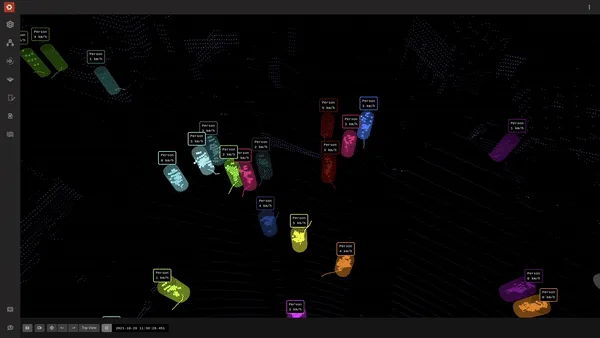
Using Outsight's lidar software for creating a zone of interest for passenger tracking

Shift’s capabilities include accurate localization and continuous tracking of the passenger journey in a fully anonymous manner. Infrastructure operators such as airports are readily provided with dozens of KPIs for each specific zone of interest, along with immediate alarms and statistics.

Shift is revolutionizing how airports manage and monitor passenger flow and vehicle traffic, providing unparalleled spatial analytics capabilities.

LiDAR Manages Increased Airport Traffic

See how and why Airports are increasingly using LiDAR-based software solutions to tackle their biggest challenges, leveraging the unique value of Spatial Intelligence.

Read article →

“This award not only signifies Outsight’s achievements and leadership recognition but also marks the evolution of LiDAR into a mature technology.”
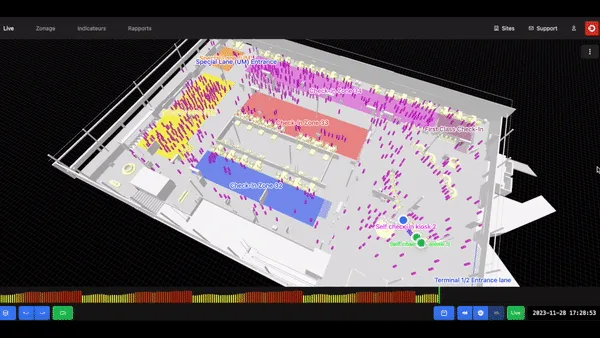
Outsight's 3D Spatial AI software accurately tracking passengers in a space

Raul Bravo, President, and co-founder of Outsight, expressed his enthusiasm for the award.

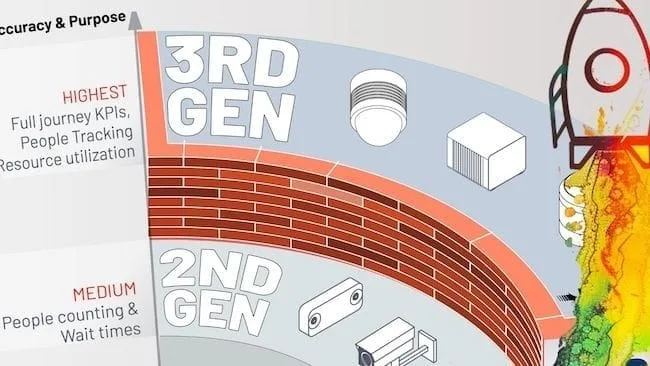
“Now deployed at scale in major international airports, LiDAR emerges as the third generation of people and vehicle monitoring technology, surpassing the adoption of the second generation, stereo-vision cameras, deployed over a decade ago.”

Introducing 3rd Gen People Counting Technology

Mirroring the technological evolution seen across various industries, People Tracking and Counting Technologies have already entered their third generation.

Read article →
“Once again, airports are at the forefront of technological advancement, driving more efficient operations, enhancing passenger experiences, and elevating safety standards.”

For more information about Outsight and its innovative solutions, please visit outsight.ai.


Related Articles

AWARDS

Outsight Wins the Terminal Excellence Innovation Award at Inter Airport Europe 2025

The award highlights how our cutting-edge 3D LiDAR-based Spatial Intelligence solutions have contributed to airport innovation across Europe and beyond.

TECHNOLOGY

Outsight enters the Intel® Partner Alliance as a Gold Member

Together with Intel, we are set to deliver unprecedented solutions in the emerging field of Spatial AI.

Let's connect

Send us a Message

Drop your email and we'll get back to you as soon as possible.

Frequently Asked Questions

  • What generation of people counting technology is LiDAR considered, and what came before it?

    LiDAR-based tracking is considered the third generation of people and vehicle monitoring technology. The first generation used basic counters such as infrared beams and inductive loops. The second generation adopted stereo-vision cameras, deployed at scale in airports roughly a decade ago. LiDAR surpasses that second generation in depth accuracy, coverage range, and privacy properties, since it captures geometry and motion rather than images. Outsight formalizes this progression through the concept of the Motional Digital Twin, a real-time 3D replica of how people, vehicles, and robots move through a site, built on infrastructure-mounted LiDAR rather than on the moving entities themselves.

  • How does a multi-vendor LiDAR platform handle sensors from different manufacturers in the same deployment?

    A hardware-agnostic LiDAR software platform ingests raw point clouds from sensors made by different manufacturers and normalizes them into a single unified 3D scene. Each sensor's output is registered to a shared coordinate system during calibration, so a mixed-hardware deployment, where one zone of an airport uses one sensor brand and another zone uses a different brand, feeds the same analytics pipeline without requiring separate processing stacks per manufacturer. Outsight's SHIFT platform takes this approach across sensors from Hesai, RoboSense, Ouster, Velodyne, and Seyond, all unified into one real-time pipeline. This multi-vendor compatibility is particularly relevant in large-scale airport environments, such as the deployment at Dallas Fort Worth, where infrastructure scale and phased hardware procurement make vendor flexibility a practical necessity.

  • What KPIs does a spatial intelligence platform typically deliver to airport operators?

    Airport operators typically receive KPIs covering occupancy per zone, passenger queue length and estimated wait time, throughput at checkpoints, dwell time in retail or gate areas, and vehicle counts at curbside drop-off zones. Alerts fire when any metric crosses an operator-defined threshold, such as a queue exceeding a set length. The SHIFT platform, recognized with the 2024 Airport Technology Excellence Award, delivers these outputs as live dashboards, scheduled reports, and API feeds for integration into existing airport operations systems. Outsight applies this capability across major hub deployments, including Dallas Fort Worth and Paris-Charles de Gaulle, where the platform tracks passenger and vehicle movement through a real-time, anonymous 3D environment built from infrastructure-mounted LiDAR sensors.

  • Is LiDAR-based passenger tracking compliant with GDPR without additional configuration?

    LiDAR sensors measure surfaces using laser pulses and produce point clouds that encode position, shape, and motion. They cannot physically capture faces, skin tone, or license plates, so no personal data is ever recorded. GDPR compliance is therefore a structural property of the sensor physics rather than a software setting applied after capture. This distinguishes the approach from camera-based systems, where a separate anonymization step must be applied to footage that initially does contain identifiable imagery. Outsight's SHIFT platform is built on this principle: because its Motional Digital Twin is fed entirely by LiDAR, anonymity is guaranteed by definition at the hardware level, with no additional configuration required.

  • How does LiDAR passenger tracking perform in airside areas with high ceilings and large open spaces?

    LiDAR sensors emit laser pulses that travel long distances before returning, giving each unit a large effective coverage footprint at typical terminal ceiling heights. In wide-open concourses, fewer sensors are needed per square meter compared to camera-based or stereo-vision systems, because each LiDAR unit contributes to a shared 3D point cloud covering the full volume of the space. Multiple sensors are fused into one scene, so a person crossing from one sensor's primary zone to another continues to carry the same anonymous tracking ID without interruption. Outsight's SHIFT platform applies this principle at the scale of major hub airports, including Dallas Fort Worth, the world's largest 3D LiDAR airport deployment, where infrastructure-mounted sensors maintain continuous tracking across large airside volumes without capturing any biometric data.

  • What makes an airport technology award meaningful as a signal of vendor maturity versus a marketing exercise?

    Industry awards specific to aviation technology, such as those run by Airport Technology publications, typically evaluate vendors against criteria tied to deployment scale, operational outcomes, and integration breadth rather than product features alone. A vendor recognized across those criteria while its technology is already live in major international airports carries a different signal than an award based on product concept. Outsight's 2024 Airport Technology Excellence Award, for instance, came while its SHIFT platform was actively deployed at airports including Dallas Fort Worth, Paris-Charles de Gaulle, and Rome Fiumicino, giving procurement teams a concrete operational baseline to assess. That combination of independent recognition and verifiable live deployments is what separates a meaningful maturity signal from a marketing exercise, and it serves as a useful filter alongside certifications like ISO 27001 and SOC 2.