Skip to content
Insights
Outsight's LiDAR solution has the potential to deliver life-saving benefits to roadway users.

Pedestrian Safety Concerns Enters the Mainstream

Over 100 million Americans tuned in last Sunday to enjoy football and a halftime show, and were surprised to see an advertisement focused on vehicle technology.


The ad, which circulated widely on social media, featured a vehicle equipped with a driver-assistance system failing to detect a child-sized pedestrian mannequin and stroller.
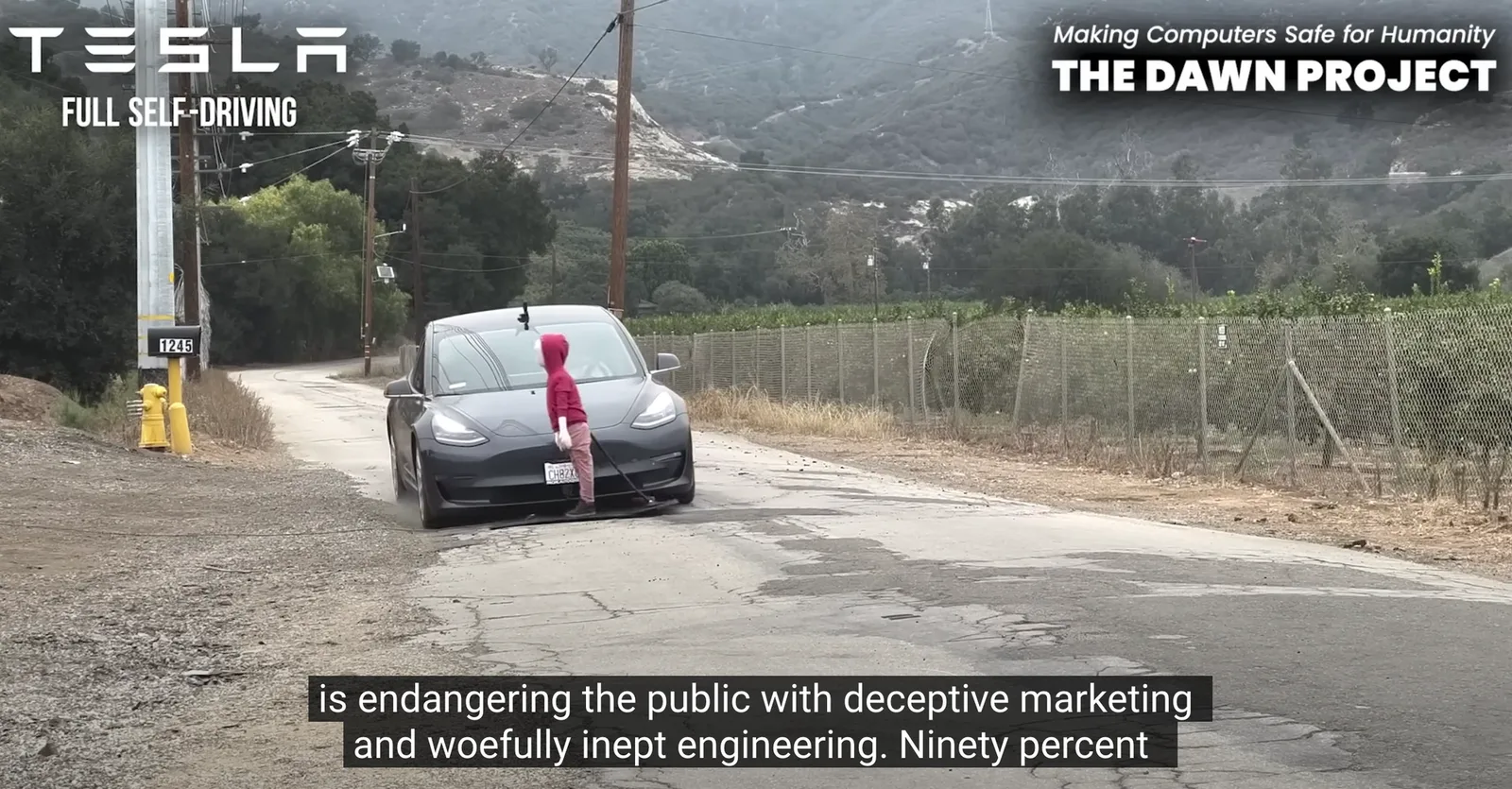
Tesla ad

This ad comes after the Governors Highway Safety Association projected that pedestrian fatalities reached a 40 year high in 2021, driven by speeding, impaired and distracted driving, and other danger driving behaviors.

The public may wonder from these statistics and the illustration of certain current technological limitations, how can vehicle technology improve safety on our roadways?

While that question may be new in the minds of the general public, the lidar industry has long been working to answer this question. Through the Lidar Coalition, the industry speaks with one voice to advocate for policies that ensure vehicle safety technology works in all conditions, particularly when detecting pedestrians.
Lidar coalition

Many current advanced driver-assistance systems rely on camera and radar sensing. Camera-based systems have limited detection capabilities in low light conditions, while radar systems have trouble detecting humans.

In contrast, lidar-based technology can detect vulnerable road users in both low light and low visibility conditions, when they are most at risk. Together, these sensors can complement each other to achieve a robust safety-enhancing effect.

This coming year, the Department of Transportation is expected to issue proposed performance standards for automatic emergency braking and pedestrian automatic emergency braking.

These standards will be critical to address the pedestrian detection issues showcased in the advertisement last Sunday. The Lidar Coalition will contribute to this effort by aiming to submit its own proposal for performance standards designed to keep all road users safe.

Technological innovation, coupled with appropriate government standards, has the potential to deliver life-saving benefits to roadway users.

The Lidar Coalition represents 10 of the leading companies in the lidar ecosystem including hardware manufacturers, tier 1 suppliers, software providers, and semiconductor developers.

Related Articles

AIRPORTS

Aeroporti di Roma to deploy Outsight's Physical AI solution at scale across Rome Fiumicino Airport

Aeroporti di Roma (ADR) is expanding its collaboration with Outsight to a large-scale deployment across almost all Schengen common-use areas at Rome Fiumicino Airport.

CORPORATE

Intel and Outsight Announce Strategic Collaboration to Bring Physical AI–Powered Spatial Intelligence to the Enterprise Edge

Outsight’s Shift platform integrated into Google Distributed Cloud Edge powered by Intel Xeon 6 SoC – Live demonstration at Google Cloud Next 2026

Let's connect

Send us a Message

Drop your email and we'll get back to you as soon as possible.

Frequently Asked Questions

  • Why did pedestrian fatalities rise to a 40-year high in the US around 2021?

    The Governors Highway Safety Association attributed the spike primarily to behavioral factors: speeding, impaired driving, and distracted driving, rather than to any single vehicle technology gap. The trend accelerated during the pandemic period, when emptier roads encouraged faster driving. Separately, the growing share of larger vehicles (SUVs and pickups) in the fleet increases fatality probability when a collision with a pedestrian does occur, independent of driver-assistance capabilities. Addressing these risks at the infrastructure level is one reason cities have turned to fixed-sensor approaches: Outsight's Motional Digital Twin, deployed at smart-city intersections such as those in Bellevue's Vision Zero program, tracks pedestrian and vehicle movement in real time to give operators the situational awareness needed to identify and act on dangerous patterns before collisions occur.

  • Why does radar struggle to detect pedestrians compared to vehicles?

    Radar measures reflected radio waves and relies on the radar cross-section of an object. Metal vehicle bodies produce a strong, consistent return, while human bodies produce a weak, irregular return at typical automotive radar frequencies, making it difficult to distinguish a pedestrian from background clutter, especially at low relative speeds or when the pedestrian is moving perpendicular to the sensor. LiDAR, which measures laser-pulse returns, captures the 3D geometry and motion of any object regardless of its material composition, giving pedestrians a reliable detection profile. Outsight applies this principle at infrastructure scale through its SHIFT platform, using LiDAR sensors mounted in fixed infrastructure to track pedestrian movement in real time, an approach already deployed at smart-city intersections such as those in the City of Bellevue's Vision Zero program.

  • What is pedestrian automatic emergency braking and how does it differ from standard AEB?

    Standard automatic emergency braking (AEB) targets vehicle-to-vehicle collisions, using forward-facing sensors to detect a decelerating lead vehicle and apply the brakes automatically. Pedestrian AEB extends that pipeline to detect vulnerable road users such as walkers, cyclists, and children, who present smaller, less reflective profiles and far less predictable trajectories. The US Department of Transportation was expected to issue separate proposed performance standards specifically for pedestrian AEB, recognizing that the detection challenge is distinct enough to require its own technical criteria. That same detection complexity, distinguishing human movement from background clutter in real time, is why infrastructure-based approaches like Outsight's Motional Digital Twin have been deployed at smart-city intersections, such as those in the City of Bellevue's Vision Zero program, to monitor and analyze pedestrian and vehicle movement independent of any single onboard system.

  • What is the Lidar Coalition and who are its members?

    The Lidar Coalition is a policy advocacy body that speaks collectively on behalf of the LiDAR industry in regulatory proceedings, particularly around vehicle safety standards. Its membership spans the full technology stack: LiDAR hardware manufacturers, tier-one automotive suppliers, software providers, and semiconductor developers, covering 10 leading companies at the time this article was published. The coalition engages directly with regulators, including the US Department of Transportation, to shape performance standards for pedestrian detection. LiDAR perception extends beyond vehicles as well: Outsight applies infrastructure-based LiDAR at scale through its SHIFT platform, tracking pedestrian and vehicle movement in real time at sites such as airports, train stations, and smart-city intersections, including Vision Zero deployments with the City of Bellevue.

  • Can camera-based ADAS systems detect pedestrians in darkness or fog?

    Camera-based systems depend on ambient or vehicle-generated light to form an image, which limits detection reliability in low-light conditions such as night, heavy rain, and fog. Thermal cameras extend some capability into darkness but add cost and have their own limitations in rain. LiDAR is an active sensor that emits its own laser pulses and measures their return, making it independent of ambient lighting. This is why multi-modal sensor fusion, combining cameras and LiDAR, is the architecture most safety engineers favor for reliable pedestrian detection across all conditions. Outsight builds on this principle through infrastructure-based LiDAR deployments, such as its work with the City of Bellevue on Vision Zero intersections, where the SHIFT platform tracks pedestrians and vehicles in real time regardless of lighting or weather.

  • Do government performance standards actually change what sensors automakers use in ADAS?

    Yes, because performance standards define the test scenarios a system must pass, not the specific sensors it must use. If a standard requires reliable pedestrian detection at night, at oblique angles, and for child-sized targets, camera-only systems that fail those tests face regulatory non-compliance. This creates a direct commercial incentive to add or switch to sensors that meet the bar. The US NHTSA has historically used standard-setting to accelerate sensor adoption, as seen with rear-view camera mandates where the standard drove near-universal fitment within a few model years. LiDAR-based perception systems are increasingly well-positioned to satisfy these tighter test criteria, a dynamic reflected in deployments like those Outsight runs at BMW and other automotive manufacturing facilities, where infrastructure-based 3D LiDAR tracks people and vehicles with the precision that performance-driven use cases demand.