Skip to content
Insights
INDRA's and Outsight's partnership

Strategic partnership agreement between Outsight and INDRA

This agreement will accelerate the deployment of 3D LiDAR-based Artificial Vision in Smart Transport Infrastructure!


Originally developed for the automotive industry, LiDAR generates 3D data with unrivaled precision and has become, thanks to proper processing software, a very competitive technology to help transport operators and infrastructure managers improve their service and elevate the end customer experience.

This agreement will facilitate the deployment of LiDAR technology and its software, which enables the monitoring of people, cargo, and vehicle movements, in airports, stations, transport hubs or logistics centres, for commercial, operational and passenger experience purposes.

Outsight and Indra’s Partnership

This strategic agreement will accelerate the use of 3D LiDAR-based Artificial Vision for the Mobility business, to deploy innovative applications in intelligent transport infrastructures, such as airports, train or bus stations, ports or logistics centres, for both operational and commercial purposes and to improve the passenger experience.

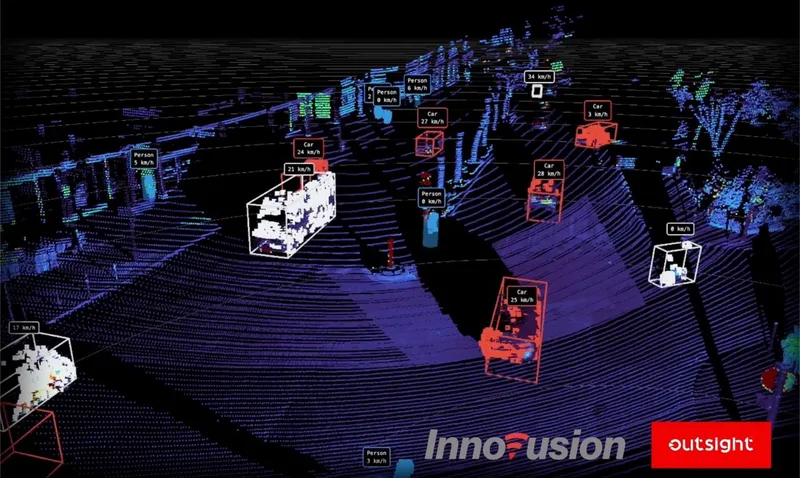
LiDAR technology can track the movement of vehicles, goods and people, while respecting anonymity, and is capable of operating in any weather or lighting conditions, offering a cost-effective, high-performance alternative to traditional analysis technologies based on cameras, radar or ultrasonic sensors.

Understanding How Lidar Works

3D LiDAR is a complex technology that enables unprecedented Spatial Intelligence. Many engineering choices are possible when building a new device.

Read article →

This technology, coupled with Indra’s ability to integrate additional data sources, will enable infrastructure operators to optimise operational efficiency, understand the commercial potential of their resources and improve the safety and security of facilities, as well as the traveller experience.

It also provides key information for proactive decision making, improved fluidity of movement and optimisation in different transport applications.

A unique value proposition

The 360° solution proposed by Indra and Outsight will transform raw data from any LiDAR as well as data captured by transport infrastructure systems into actionable information and intelligence.

The position, movement and speed of passengers, as well as cargo and vehicles are converted into “profiles”, in accordance with the Data Protection Act, and into actionable KPIs.

LiDAR Manages Increased Airport Traffic

See how and why Airports are increasingly using LiDAR-based software solutions to tackle their biggest challenges, leveraging the unique value of Spatial Intelligence.

Read article →

This provides operators with detailed information to optimise real-time and strategic passenger and cargo flows, pricing strategies, technological investments, revenue and resource management, among other benefits.

Thanks to this agreement, Outsight will have a strong industrial partner, a global leader in engineering technology, to extend the use of its technology, whilst Indra will reinforce its position as a leader in the smart mobility area.

We are already using 3D Computer vision perception technologies like LiDAR to address safety and security challenges and improve operations efficiency. This partnership with a forward-thinking company like Outsight enables us to tackle additional challenges that unfold commercial benefits to our customers and elevate the customer’s and end-users’ experience”- said Lidia Muñoz, Commercial Global Director and Airports and Port Director, Mobility at Indra.

According to Raul Bravo, President and Founder of Outsight,

Our strategic partnership with Indra, a renowned global technology leader, propels us forward in meeting the growing demands of the market and addressing safety, security, commercial and operational efficiency challenges across various large-scale smart infrastructure applications”.

About Indra

Indra (www.indracompany.com) is one of the leading global technology and consulting companies and the technological partner for the core business operations of its customers worldwide.

It is a world-leader in providing proprietary solutions in specific segments in Transport and Defence markets, and a leading firm in Digital Transformation and Information Technologies in Spain and Latin America through its affiliate Minsait.

Its business model is based on a comprehensive range of proprietary products, with a high-value, end-to-end focus and with a high innovation component. In the 2022 financial year, Indra achieved revenue totaling 3,851 million euros, with almost 57,000 employees, a local presence in 46 countries and business operations in over 140 countries.
Related Articles

AIRPORTS

Aeroporti di Roma to deploy Outsight's Physical AI solution at scale across Rome Fiumicino Airport

Aeroporti di Roma (ADR) is expanding its collaboration with Outsight to a large-scale deployment across almost all Schengen common-use areas at Rome Fiumicino Airport.

CORPORATE

Intel and Outsight Announce Strategic Collaboration to Bring Physical AI–Powered Spatial Intelligence to the Enterprise Edge

Outsight’s Shift platform integrated into Google Distributed Cloud Edge powered by Intel Xeon 6 SoC – Live demonstration at Google Cloud Next 2026

Let's connect

Send us a Message

Drop your email and we'll get back to you as soon as possible.

Frequently Asked Questions

  • What does Indra actually do in the transport and mobility sector?

    Indra is a Spain-based global technology and engineering company with a dedicated mobility division covering airports, ports, rail, and logistics. It serves customers across more than 140 countries and reported revenue of 3,851 million euros in 2022 with nearly 57,000 employees. In transport infrastructure, Indra builds the integration layer: connecting sensors, operational databases, and business systems into unified control platforms. That integration role is what makes a partnership with a LiDAR perception vendor like Outsight operationally meaningful at scale. By combining Indra's systems integration depth with Outsight's SHIFT platform and its real-time 3D object tracking, the two companies can deliver end-to-end Physical AI capabilities across smart transport infrastructure in airports, rail stations, and beyond.

  • How does a LiDAR vendor partnering with a systems integrator actually speed up airport deployments?

    A dedicated LiDAR perception vendor provides the sensor processing and spatial analytics stack, but airports already run AODB, baggage handling, and security management systems that any new data feed must connect to. A systems integrator with existing contracts and certified interfaces at those airports removes the re-negotiation and certification overhead for each new site. In this partnership, Outsight contributes the SHIFT platform, which covers real-time 3D perception, situational awareness, and open integrations out of the box, while INDRA brings established relationships and certified touchpoints across smart transport infrastructure. The result is that a perception capability that might take 18 months to integrate independently can reach operational status faster because the integration framework already exists on the operator side.

  • Can LiDAR track cargo and vehicles at the same time as passengers inside a transport hub?

    Yes. A single infrastructure-mounted LiDAR deployment classifies multiple entity types simultaneously: pedestrians, wheeled vehicles (including luggage carts and ground-support equipment), and cargo pallets or containers within sensor range. Each entity type receives a distinct classification and a persistent anonymous ID, so flow metrics for passengers and throughput metrics for cargo are generated from the same sensor network without separate deployments. Outsight's Motional Digital Twin applies exactly this multi-class approach across transport hubs, tracking people, vehicles, and objects together in real time through infrastructure-mounted sensors rather than device-carried ones. This capability is particularly relevant at airports and logistics centres where airside and landside movements overlap, as demonstrated at deployments such as Dallas Fort Worth and Paris-Charles de Gaulle.

  • Why are transport hub operators moving away from camera-based analytics toward LiDAR?

    Camera analytics depend on sufficient and consistent lighting, struggle with occlusion in dense crowds, and produce image data that creates GDPR and privacy-management overhead. LiDAR operates in any lighting condition (darkness, direct sun, fog) and captures geometry rather than images, so privacy compliance is structural rather than a post-processing step. Outsight's infrastructure-based approach takes this further: its SHIFT platform processes 3D LiDAR point clouds in real time, tracking people and vehicles anonymously by shape and motion, never capturing faces, license plates, or biometric data. For transport hubs that run 24 hours, handle thousands of simultaneous entities, and operate under strict data-protection frameworks, removing the privacy compliance burden while gaining accurate 3D tracking represents a meaningful operational and legal simplification.

  • What does 'artificial vision' mean in the context of smart transport infrastructure?

    In transport and ITS contexts, "artificial vision" refers to machine perception systems that extract structured information from sensor data: detecting, classifying, and tracking objects in real time rather than simply recording video. LiDAR-based artificial vision differs from camera-based computer vision in that it works from 3D point clouds rather than 2D images, giving operators metric measurements such as position, speed, trajectory, and dwell time rather than visual descriptors. Outsight's approach to this problem, embedded in the SHIFT platform, processes that 3D point-cloud data through a sub-50ms end-to-end pipeline and feeds the resulting structured spatial data directly into operations dashboards and decision-support tools. The output is anonymous by definition, since LiDAR geometry captures shape and motion without recording faces, license plates, or other biometric identifiers.

  • How are passenger movements turned into actionable KPIs without storing personal data?

    LiDAR sensors capture geometry and motion, not faces, license plates, or biometric attributes. Each detected entity is assigned an anonymous temporary ID at entry and tracked by position, speed, and trajectory until it exits the monitored area. This is the approach Outsight calls anonymous by definition: because LiDAR never records a personal identifier in the first place, there is nothing to anonymize after the fact. From those trajectories, the Outsight SHIFT platform computes aggregate KPIs including queue depth, wait time, throughput per lane, dwell distribution by zone, and flow rate between areas. The KPI pipeline is therefore compliant with data protection regulations by construction, a property that has made this architecture practical for deployments at airports such as Dallas Fort Worth and Paris-Charles de Gaulle, where passenger volume and privacy obligations both run high.