Whitepaper
Dynamic World Models
A living, anonymous 3D understanding of how people, vehicles and robots move and interact across entire sites, giving Physical AI the real-world ground truth it needs.

Abstract
This whitepaper describes Dynamic World Models: continuously measured representations of how every person, vehicle and robot moves, behaves and interacts within large infrastructure sites, across hundreds of thousands of square meters, from raw physical motion to semantic meaning.
AI is moving into the physical world. World models are learning to render, simulate and plan in 3D, while Ambient Intelligence turns physical environments into spaces that sense, understand and adapt. Both depend on a scarce resource: real-world 3D data that captures how the world actually behaves.
Dynamic World Models provide this foundation. Infrastructure-based Physical AI fuses 3D-native sensor data, such as LiDAR, with cameras, wireless, POS and other business systems to build a living, semantic and fully anonymous 3D representation of everything happening on site. Each individual carries a unique anonymous ID enriched with roles, events, relationships, intent and causes. Grounded in real 3D measurements and processed in under 50 ms end-to-end, all this information shares one consistent reference in space and time, so every source can be fused, every event linked, and every question answered reliably, from what is happening now to what comes next.
From airports and rail stations to hospitals, sports venues and factories, Dynamic World Models run in production at scale across some of the most critical sites on five continents. As a global leader in Spatial Intelligence, Outsight processes 2 TB of 3D data every minute, generating real-world data at unprecedented scale and depth. One shared representation serves operators, AI agents and robots in real time, and grounds the training and simulation of Physical AI models in reality.
As world models evolve from synthetic data toward real-world grounding, and from static aspects of the world toward everything that moves within it, Dynamic World Models bridge simulation and reality, enabling continuous Real-to-Sim-to-Real loops and connecting the next generation of Physical AI and Ambient Intelligence to the physical world.
The Next AI Frontier: Digitizing the Dynamic Physical World
AI has mastered the digital traces of human activity: text, audio and images. Its next leap is into the physical world itself, where nothing stands still.
Text, Time-Series, LLMs
Knowledge & processes
VLMs, Multi-Modal data
Human Digital Interaction
First World Models, Spatial AI
Static physical world
Dynamic World Models, Physical AI
Dynamic physical world
People, vehicles and robots live inside a continuous stream of motion, shaped by each other and by the spaces they share. Perceiving that motion, making sense of it and responding to it in real time is the defining challenge of Physical AI.
It is also where AI sees least. Maps, 3D models and physics simulations describe the world as it is built and the laws that govern it, while the live flow of everything moving through it remains largely invisible, beyond the reach of any single camera, sensor, simulator or robot.
Digitizing movement at the scale of entire sites closes that gap. It makes 3D the fourth major data modality of AI, alongside text, audio and image, and it is the foundation that everything in this whitepaper builds on.
Ambient Intelligence Meets World Models
World models are AI systems that learn an internal representation of an environment, allowing them to predict how it will evolve and to anticipate the consequences of actions before they are taken.
They serve three functions. They render views of a world for people to see. They simulate its state, with faithful geometry, physics and dynamics. They plan actions for agents and robots operating within it. These three functions are converging into unified foundation models that can perceive, predict and act in 3D.
As world models evolve from synthetic data generation toward real-world grounding, each of these functions increasingly depends on an accurate description of what is actually happening in the world at any given moment.
In its Hype Cycle for Physical AI, 2026, Gartner describes Ambient Intelligence as the evolution of smart spaces into environments that sense, respond and adapt to the people and things within them, in a proactive, context-aware and interface-free way. To behave this way, an environment needs a live understanding of everything happening within it, and this is precisely what a Dynamic World Model provides.
Outsight named in the Gartner Hype Cycle for Physical AI, 2026
Gartner names Outsight a leading vendor in Ambient Intelligence, alongside AWS, Google, Microsoft and Siemens, confirming its lead in infrastructure-based Physical AI.
Read article →

3D-based Multi-modal Insights
Creating Spatio-Temporal Consistency
Thanks to the Localization process using 3D data from native 3D sensors such as LiDAR, a Dynamic World Model can integrate information from multiple sensors and external sources into a consistent, unified spatial reference.
The Missing Ingredient: Real-World State
Unlocking Premises-wide Situation Awareness
A Dynamic World Model is the continuously measured physical and semantic state of everything that moves within a real space: every person, vehicle, robot and item, with its position and motion, its role and profile, its interactions and relationships, its intent and the causes behind what happens, held in one persistent 3D and temporal reference.
Video is abundant and captures how the world looks.
3D data with explicit geometry is orders of magnitude scarcer, and world models still rely largely on it in the form of static scenes and synthetic environments that describe how the world is built.
Real-world 3D capture of people, vehicles and robots moving and interacting, at the scale of entire sites, is scarcer still. It is the data that describes how the world actually behaves, and the data Ambient Intelligence produces, in real time and in real environments.
Most industry analysts point to access to real-world data at scale, together with privacy, as a core obstacle for world models, and to causal reasoning as one of their hardest challenges. Simulation scales variation, yet systems trained in idealized conditions struggle when they meet the complexity of real operating environments.
The Physical-to-Semantic Stack
A Dynamic World Model continuously delivers insights on each individual’s Profile (who¹), Position (where²), Behavior and Interactions (what³), Relationships and Causes (why⁴), instantly, historically (when⁵), and predictively (what if⁶).
| ¹ | Each person, vehicle or robot carries a unique anonymous ID, so every action and event is tracked and associated. |
| ² | Positions are updated continuously, with the precision each application requires. |
| ³ | Interactions with other entities and with infrastructure assets reveal behavioral patterns. |
| ⁴ | Observed relationships and inferred causes, each with a confidence level, explain why things happen. |
| ⁵ | Every data point is time-stamped, enabling fusion with external sources and historical analysis. |
| ⁶ | This data drives real-time alerts and predictions, and the training and simulation of agentic systems. |
At the core of a Dynamic World Model is a Physical AI layer that continuously models movement, attributes, and interactions from infrastructure perception within a shared premises-wide spatial and temporal reference.
By structuring reality at the level of individual entities and events, the system builds a coherent, evolving understanding of how people, vehicles, and assets behave across a premises.
This infrastructure-level intelligence supports advanced operational insights and serves as a global and shared time-aware context that operators, agents and robots can leverage beyond their local, line-of-sight perception.
- Individual Position and Movement: current location, historical trajectory, dwell times and queuing.
- Profiling and Attributes: staff vs. visitor, adult/child, wheelchair, car/bus, external information and other attributes linked to each person (e.g. POS data).
- Events (Time and Location): interactions with physical resources, zones of interest and touchpoints (arrival/leaving time, joining a queue, made purchase).
- Business Assets Utilization and Analytics: equipment use, seats, boarding gates, check-in counters, sanitaries, immigration desks and any other asset.
Foundational Principles
Infrastructure-level intelligence
What every robot, agent and operator gains from a Dynamic World Model.

Premises-wide
Understanding
Infrastructure sensors capture the position and movement of every person, vehicle, and robot in 3D and in real time, delivering spatial insights at scale.
This acts as an omniscient layer of understanding available to any robot or agent, regardless of its onboard sensing and processing capabilities.

Persistent Shared
Memory
Continuous tracking assigns a unique ID to every entity and maintains context over time, building a historical record of movements, interactions, and events.
This persistent memory allows leveraging past data collected across the entire environment, not just from their own sensors or synthetic generation.

Reasoning
and Planning
Delivering premises-wide actionable insights enables demand forecasting, route optimization, resource allocation and proactive decision-making.
Robots and agents can plan based on predicted conditions and multi-step reasoning rather than reacting only to immediate observations and local awareness.

Control
and Safety
Premises-wide situational awareness makes any robotics solution inherently safer by detecting risks beyond individual robot perception.
Operators retain full visibility through dashboards, alerts, and timeline replay, with intervention capabilities to ensure compliance.
Key Features
Real-time Premises-wide Awareness
Six ready-to-use features that extend every robot’s awareness to the entire site.
| Feature | What it delivers |
|---|---|
| Shared 3D Map and Navigation | A single 3D map serves robot navigation, localisation and flow monitoring, reducing onboard computation while enabling route selection based on real-time conditions within 50 ms latency. |
| Continuous Individual Tracking | Every person, vehicle, and robot receives a unique ID maintained across the entire environment, enabling persistent Situation Awareness. |
| Occlusions-free Perception | Infrastructure sensors act as an omniscient perception layer, providing robots with complete spatial awareness beyond the limitations of their onboard sensors. |
| Multi-Modal Sensing | Contextual information from different sensor modalities is fused into a unified spatial reference, enriching robot perception beyond what onboard sensors can capture alone. |
| Assets Interactions and Events | Real-time operational context from the infrastructure enables robots to optimize workflows based on resource availability, occupancy, and activity patterns. |
| Alerts, Reports and Timeline | A shared layer of notifications, alerts, and historical playback enables coordinated responses to events triggered by robots, infrastructure sensors, or a combination of both. |
Core Properties
The transformative impact of Dynamic World Models is built upon a foundation of unique properties.
| Property | What it means |
|---|---|
| Movement-driven | Examines reality from the perspective of motion and behavioral data, rather than static structural information or simple sensor readings. |
| Real-world | Focuses on physical reality and tangible environments, not merely virtual representations or synthetic scenarios. |
| Individual data | The capability to attach information and insights to each individual moving entity, rather than relying solely on aggregated or statistical data such as general flow dynamics. |
| Continuous Tracking | The capability to track the position of each individual object or person through space and time, maintaining a consistent unique identifier throughout their complete presence within the site. |
| Spatial Interactions | Capturing not only positions, but also how individuals behave and interact in real-world environments, with each other, available assets, and their surroundings. |
| High Frequency | Data capture rates must be consistent with individual movement dynamics specific to the context (e.g., capturing a person’s running speed in indoor environments or maximum driving speeds in roadway infrastructure). |
| Precision | Spatial accuracy must be consistent with the behaviors and interactions that must be captured (e.g., sub-20cm precision for person-to-person interactions in crowded environments, or sub-1-meter accuracy in parking monitoring applications). |
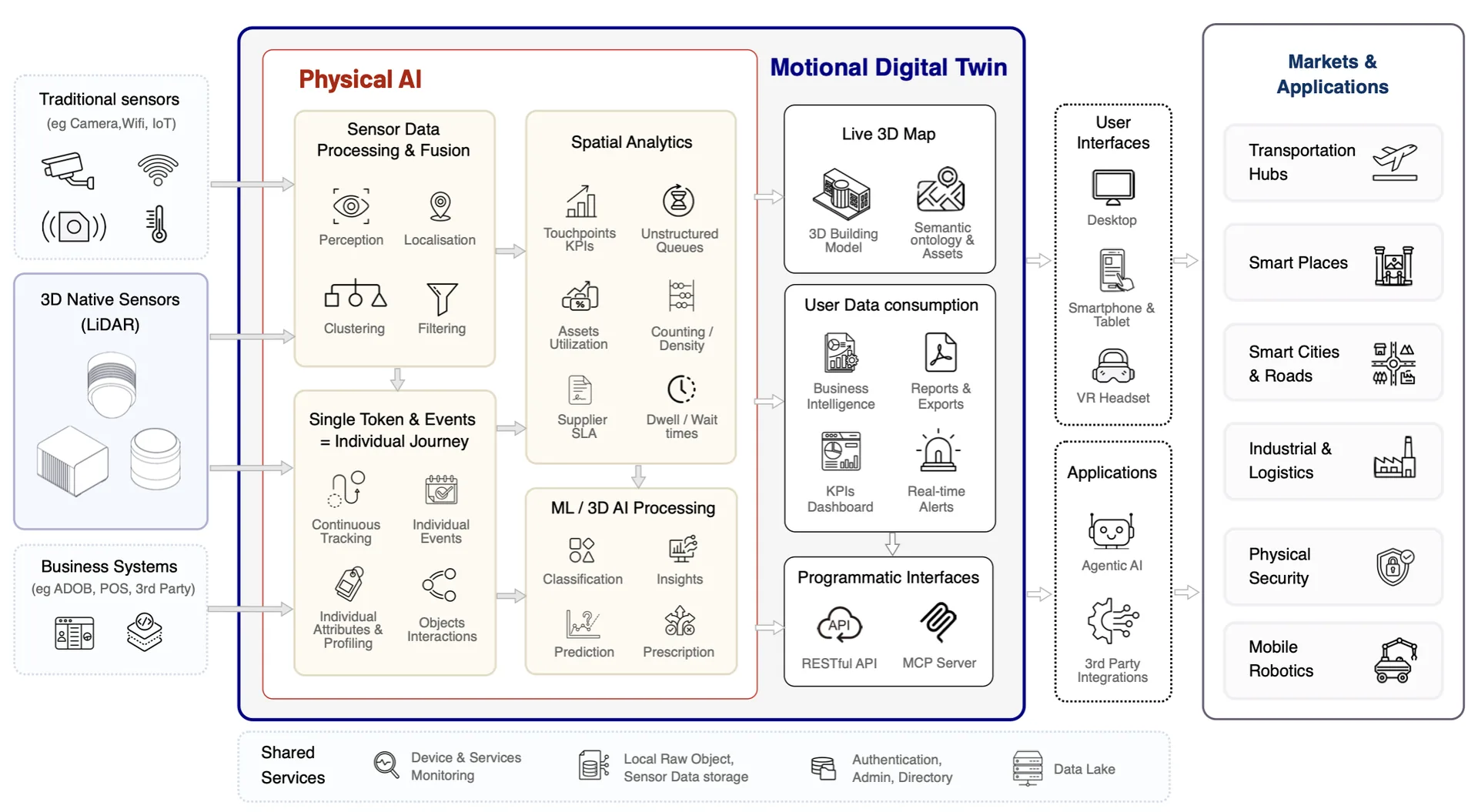
Functional Architecture
Physical AI builds the Dynamic World Model, and the Motional Digital Twin brings it to life for operators, AI agents and robots in any industry.
Why Now?
Six main drivers have converged
The need to precisely monitor, understand and predict the physical flow of people, vehicles and robots as they move is not new.
However, the comprehensive capabilities of a Dynamic World Model cannot be realised using legacy technologies.
Today, a combination of technological advancements, market dynamics, and evolving societal expectations have converged to reshape what is possible, with two main pillars forming the foundation.
-
Native 3D Sensors
LiDAR sensors, the only technology capable of accurately perceiving in 3D over long distances, are now both mature and affordable.
-
Physical AI
Comprehensive Spatial Intelligence software platforms, leveraging 3D AI, such as Outsight's, are ready and proven at scale.
Additional drivers
-
Edge Computing
Processing massive 3D data in real time is now possible with next-generation edge hardware combined with cloud computing.
-
Web-based 3D
A 3D-native interface that perfectly complements Spatial insights can currently run seamlessly in web applications with a simple browser.
-
Privacy Concerns
Rising privacy concerns are fuelling public resistance to image-based and wireless surveillance, requiring respectful alternatives.
-
Global Adoption
Leading operators across the USA, Europe, the Middle East, and Asia are deploying Outsight solutions at scale, with many more exploring adoption.
Grounding Real-to-Sim-to-Real at Site Scale
The Real-to-Sim-to-Real Flywheel
Real environments are full of variation: objects move, crowds form and dissolve, layouts change, and human behavior adapts continuously.
Robot experience is expensive to collect, and evaluating new behaviours often depends on physical hardware and on-site testing.
Real-to-Sim-to-Real approaches address this by starting from the real world, generating realistic variations in simulation, and validating results back in reality.
The quality of this loop depends on the quality of the real-world data that feeds it.
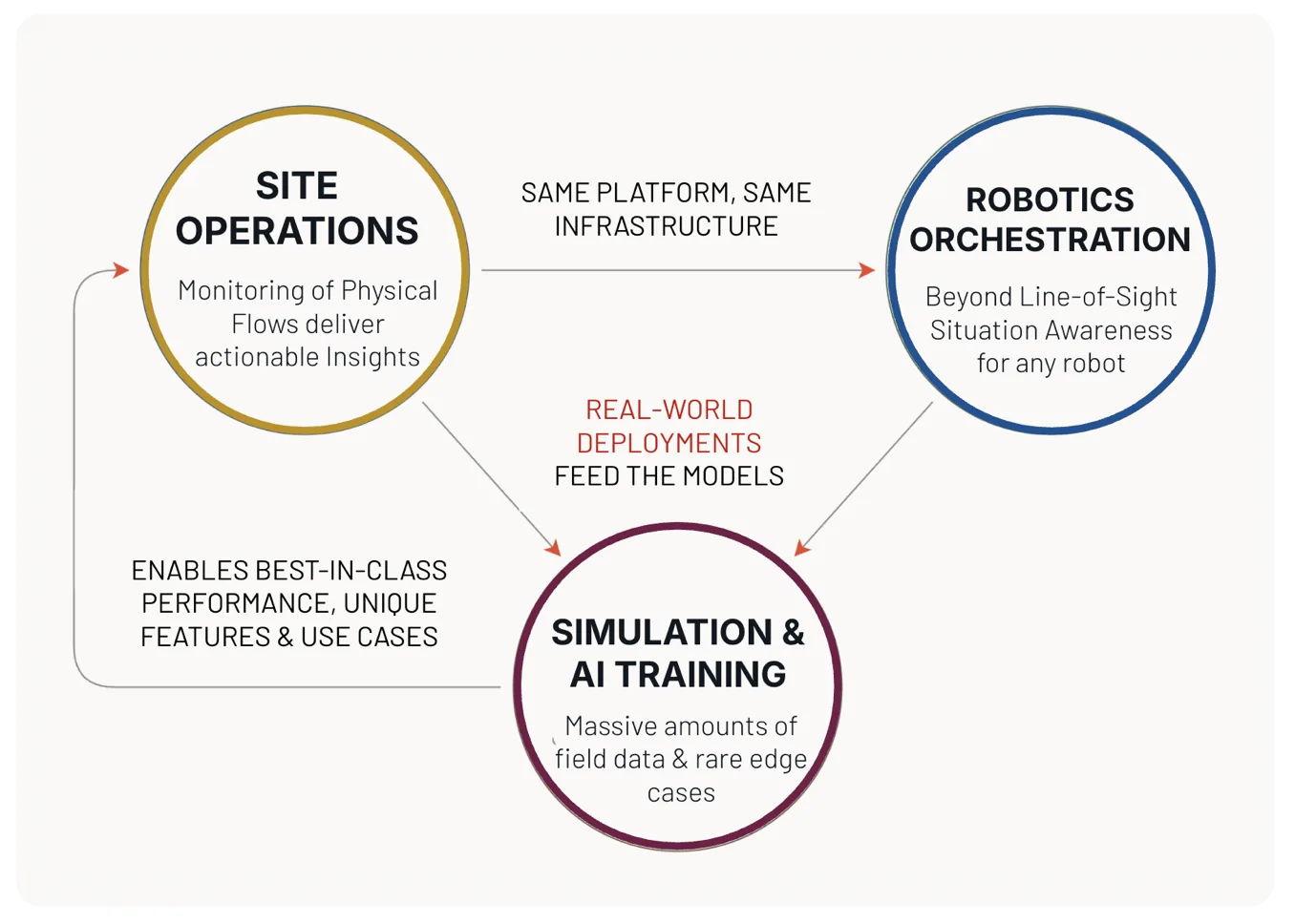
Dynamic World Models turn the Real-to-Sim-to-Real loop into a continuous flywheel on a single platform. Operators use them to monitor physical flows and act on real-time insights, and the same infrastructure gives any robot on site beyond-line-of-sight situation awareness.
Both generate real-world data at massive scale, including rare edge cases, self-annotated with events, relationships, intent and causes. This data feeds simulation and AI training with real sites, real behaviours and real outcomes.
Models trained on it return to the field with best-in-class performance, unlocking new features and use cases, while continuous comparison with the live measured state keeps simulation aligned with reality.
Flipping the Physical AI Pipeline
Inside the Flywheel
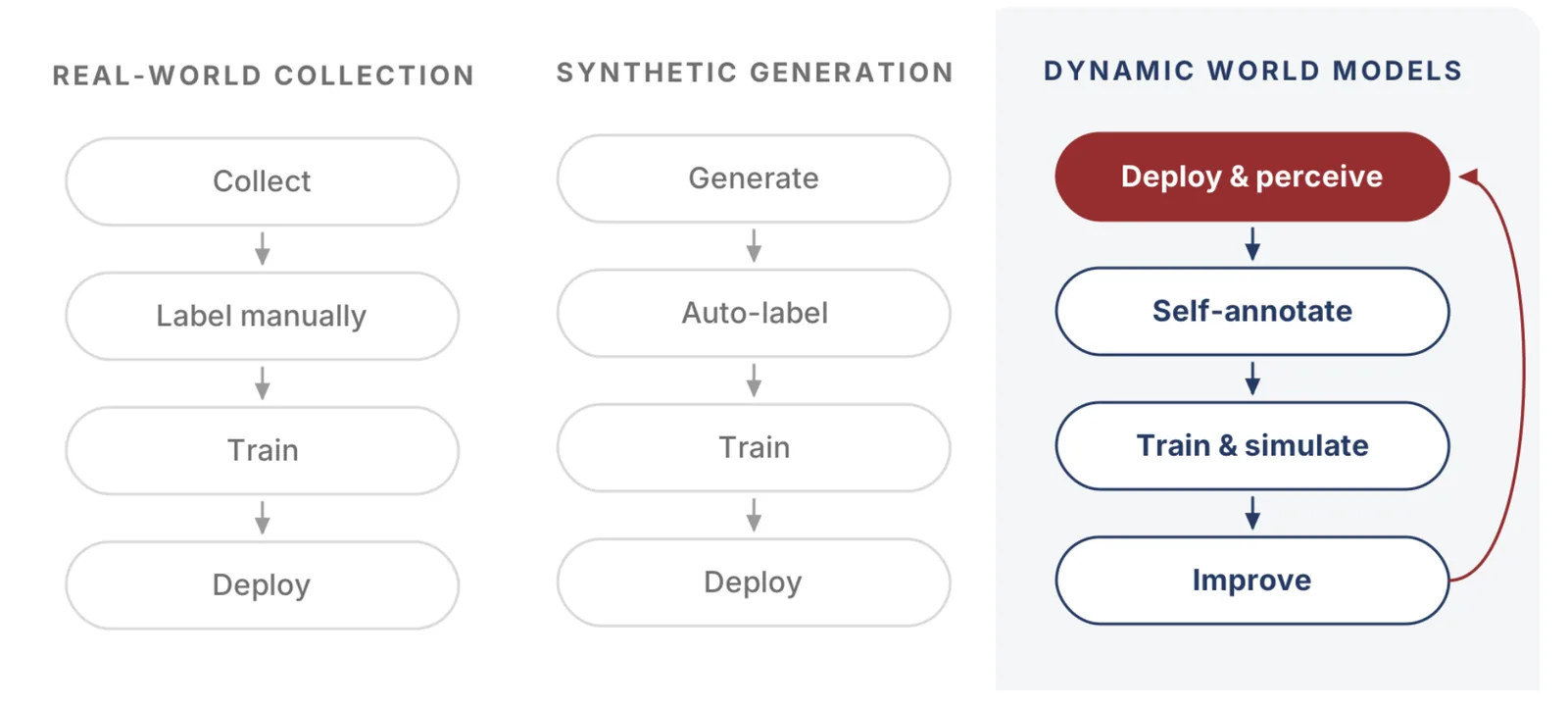
Traditional Physical AI starts with data preparation: collecting and labelling real-world data, or generating synthetic data, before any model can be trained and deployed.
Dynamic World Models reverse the order. They operate from the first day on site, and every hour of operation produces real data, labeled at the source, deterministically.
| Principle | How Dynamic World Models deliver it |
|---|---|
| Perception First, Training Second | Physical AI processes raw 3D data directly at the infrastructure edge. Localization, tracking, clustering, filtering and classification run instantly (< 50 ms end to end) on any new site, with no dataset to prepare and no model to pre-train before the first movement is measured. |
| Real Data, Labeled Like Synthetic Data | Real-world collection brings realism, but labelling it is slow and costly. Synthetic generation brings labels for free, within the limits of the simulator’s assumptions. Dynamic World Models bring both: continuous tracking assigns each entity an anonymous ID, a profile and its spatial interactions, so real-world data is structured and labeled the moment it is captured. |
| Data That Scales with Deployments | Every new site, sensor and operating hour adds diverse, real-world, self-annotated data, with no added collection effort. The training corpus grows with the deployment footprint, and so does its diversity of environments and behaviours. |
Learn More
Motional Digital Twins whitepaper
A Motional Digital Twin is the live, interactive 3D replica through which operators, AI agents and robots see, query and act on the Dynamic World Model of a site.
Read the whitepaper →

Beyond Line-of-Sight Physical AI for Robots whitepaper
How infrastructure-mounted LiDAR and Physical AI give every mobile robot a shared, real-time view of the whole premises beyond the limits of onboard perception.
Read the whitepaper →
Get free access at https://www.outsight.ai/resources/whitepapers-and-guides/
To learn more, visit our website outsight.ai or follow Outsight on LinkedIn.