
Skip to content
Insights
Costa Rica Airport selects Outsight

Costa Rica's SJO airport expands Outsight's Spatial Intelligence to new terminal areas

After a successful first phase at security and passport control, AERIS and Datacom extend Outsight's real-time people flow analytics across Costa Rica's SJO airport.


Lima, September 28, 2026. AERIS Holding Costa Rica, operator of Juan Santamaría International Airport (SJO), is extending Outsight’s People Flow Monitoring, a Spatial Intelligence solution leveraging 3D LiDAR, to new areas of the terminal. The project is delivered with Datacom, Outsight’s integration partner in Costa Rica.

The first phase covered the departure security and passport control area at the airport that welcomed more than 6 million passengers in 2025. Outsight’s Spatial Intelligence Platform went live in three weeks.
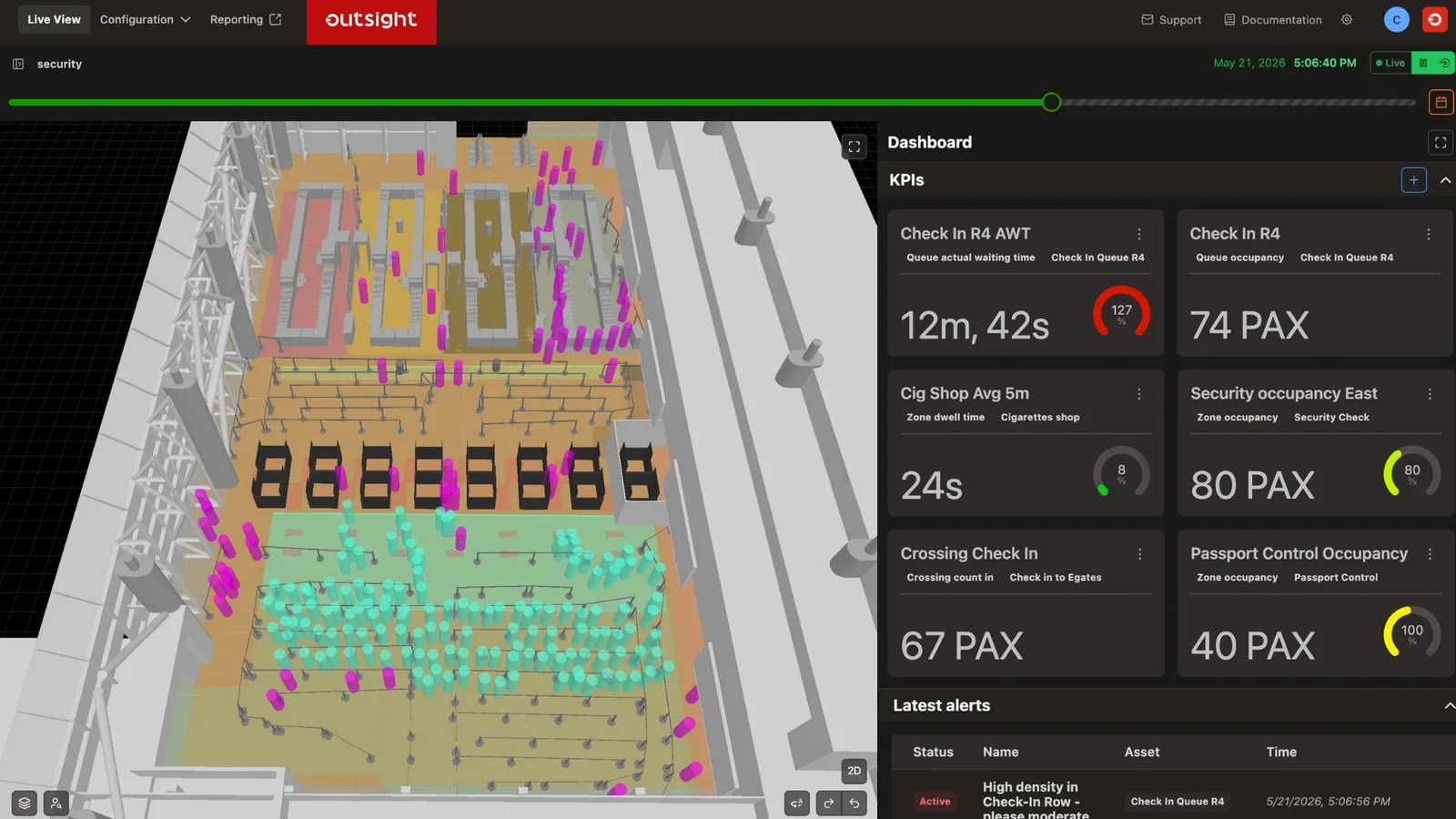
Lidar Software at Costa Rica Airport

Since then, AERIS teams have used it to measure in real time:

  • People flow across the monitored areas
  • Waiting and queue times
  • Area occupancy
  • Staffing needs by time of day

AERIS consumes the data both in Outsight’s live Dashboard and in its own data platform, through a real-time integration. This gives operations and quality teams one consistent view of how passengers move through the terminal.

The results from the first phase, in data quality and operational return, led AERIS to move ahead with Phase 2. The new phase brings the same measurement to additional passenger processing areas of the terminal. Further phases are planned as renovation work in other parts of the airport is completed.

Outsight’s Physical AI measures movement from 3D LiDAR, which can be enriched with any other available source, including cameras, WiFi, boarding pass information or POS.

“The first phase showed us what reliable, real-time data can do for our operations. We can now see queues and flows as they form and plan our resources around real demand. Extending the system to more areas of the terminal was a natural next step,” said Ricardo Hernandez, CEO, AERIS Holding Costa Rica.
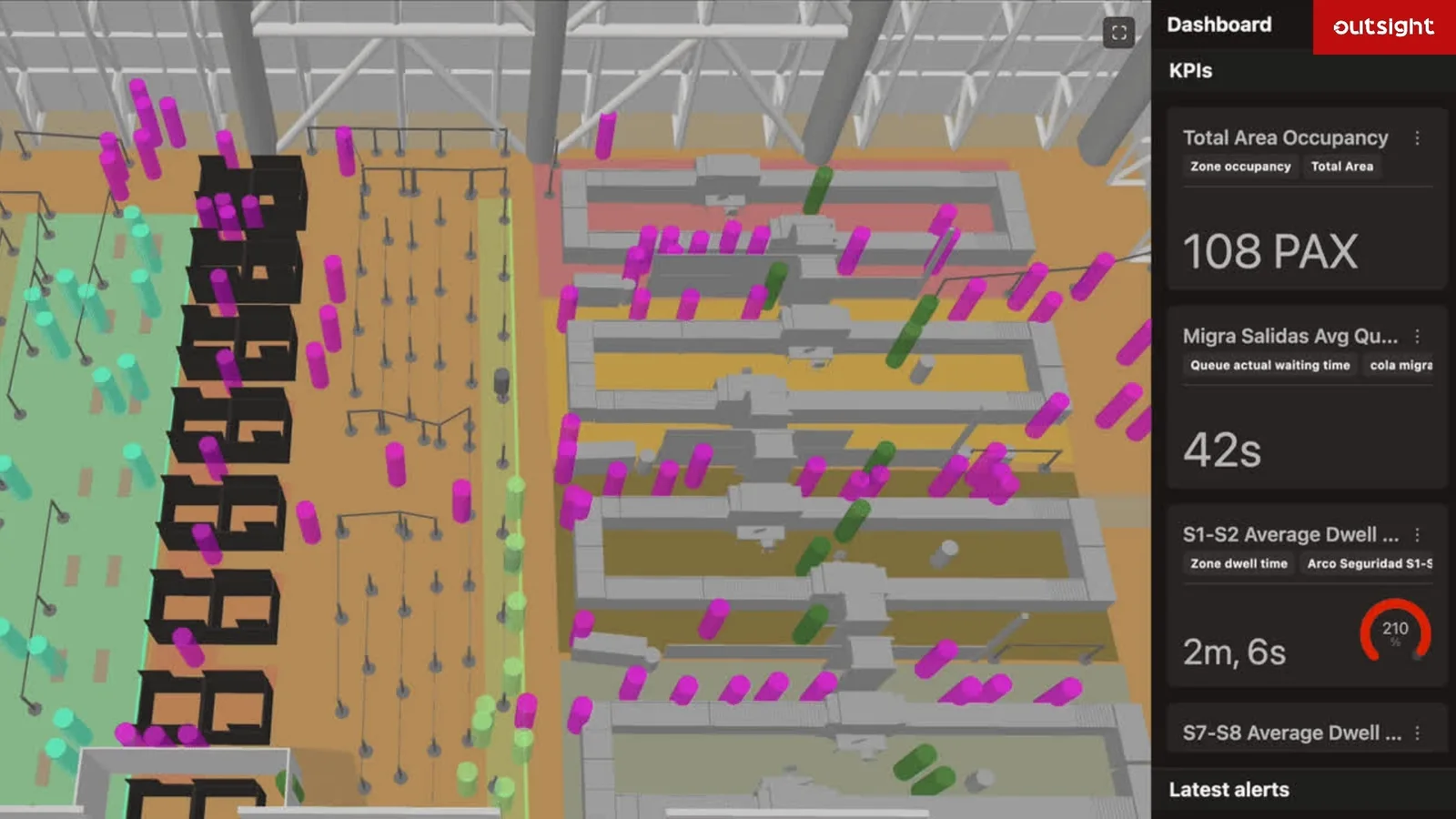
SJO Airport monitored with LiDAR

“Our role is to make sure the system runs smoothly day to day and fits into the airport’s infrastructure. This project shows what a close partnership between a local integrator and a technology provider can deliver, and we are glad to keep building it with AERIS and Outsight,” said Eduardo Gómez, Operations and Pre-sales Manager, Datacom.

“AERIS chose a production-level deployment from day one, and the results speak for themselves. Phase 2 is a strong signal of confidence, and a reference for airports across Latin America looking to manage passenger flows with accurate, privacy-safe data,” said Diego García de Paredes, LATAM Sales Director, Outsight.

See it live in Lima

More than 280 million annual passengers travel under the real-time measurement of Outsight’s Spatial Intelligence Platform, at some of the busiest airports on the West Coast, East Coast and central US, as well as Rome Fiumicino and Singapore Changi.

Outsight crosses 280 million passengers under real-time measurement, from the busiest US hubs to Singapore Changi

More than 280 million annual passengers now travel under real-time measurement by Outsight’s Spatial Intelligence Platform, from the busiest US hubs to Singapore Changi.

Read article →

Visitors to the ACI-LAC/ACI World Annual General Assembly can see a live people flow demo at Outsight’s booth (#38), from September 25 to 29.

Related Articles

AIRPORTS

Outsight crosses 280 million passengers under real-time measurement, from the busiest US hubs to Singapore Changi

More than 280 million annual passengers now travel under real-time measurement by Outsight's Spatial Intelligence Platform, from the busiest US hubs to Singapore Changi.

AIRPORTS

Outsight Joins the Airport AI Alliance to Drive Innovation in Aviation

Outsight joins the Airport AI Alliance to drive innovation and shape the future of AI-powered airport solutions. By collaborating within the Alliance, members are driving innovation in airport infrastructure.

Let's connect

Send us a Message

Drop your email and we'll get back to you as soon as possible.

Frequently Asked Questions

  • How long does it take to deploy a LiDAR people flow monitoring system at an airport?

    Deployment timelines vary by scope, but the SJO airport installation went live in three weeks from project start to operational dashboard. That speed reflects a software-first architecture: LiDAR sensors mount in fixed infrastructure positions, the processing stack configures around the site map, and zones of interest are defined in software rather than through physical modifications to the terminal. Integration with an operator's existing data platform typically runs in parallel with sensor commissioning.

  • How do airports in Latin America typically approach passenger flow data compared to European or North American hubs?

    Latin American airports have historically relied on manual observation and sample-based counting for passenger flow measurement, partly because large-scale LiDAR deployments were associated with the capital and integration resources of major hub operators. The SJO deployment illustrates a shift: a regional airport serving roughly 6 million annual passengers can run a production-grade real-time flow system, not a pilot, from day one, with a local integration partner handling day-to-day operations. That model makes the technology accessible outside the top-tier global hub segment.

  • What is the role of a local integration partner in an airport LiDAR deployment?

    A local integrator handles the physical installation, on-site maintenance, and fit into the airport's existing network and operational workflows. In the SJO project, Datacom played this role for AERIS. The division of responsibility matters: the spatial intelligence software vendor provides the perception and analytics stack, while the integrator provides the operational continuity the airport requires day to day. Without a credentialed local partner, an airport operator would have to manage the hardware layer and first-line support directly with a technology vendor based in another country.

  • Can a passenger flow monitoring system feed both an operator's own data platform and a vendor dashboard at the same time?

    Yes. The SJO deployment runs both concurrently: AERIS operations teams read from Outsight's live dashboard, while a real-time API integration pipes the same data into AERIS's own data platform. This dual-feed model is common in airport deployments where the operator wants spatial intelligence to join a broader data lake alongside flight schedule, ground handler, and retail feeds. The key requirement is a documented, stable API that emits structured event streams at a consistent rate.

  • How does phased expansion work for airport spatial intelligence projects?

    Phased expansion ties deployment scope to operational validation and, often, to physical renovation cycles. At SJO, Phase 1 covered departure security and passport control. Phase 2 adds other passenger processing areas, with further phases contingent on terminal renovation progress. This approach lets airport operators validate data quality and staff adoption before committing to full-terminal coverage, and it aligns capital expenditure with construction schedules rather than requiring a single large upfront commitment.

  • What staffing decisions does real-time queue and flow data actually change at an airport?

    Real-time queue depth and occupancy data shifts staffing from schedule-driven to demand-driven. Instead of assigning agents to checkpoints based on historical flight schedules, operations managers can open additional lanes or redeploy staff when live queue length crosses a threshold, before wait times degrade. The secondary effect is load forecasting: over weeks of data, operators identify which time-of-day and day-of-week patterns are structural versus anomalous, which informs the base schedule itself. Both the reactive and the planning benefits depend on data that is continuous and per-zone rather than aggregated.

  • What did the first phase of the deployment at Costa Rica's Juan Santamaría Airport cover?

    The first phase covered the departure security and passport control area at Juan Santamaría International Airport (SJO), which welcomed more than 6 million passengers in 2025. Outsight's Spatial Intelligence Platform went live there in three weeks. Since then, AERIS teams have measured people flow across the monitored areas, waiting and queue times, area occupancy and staffing needs by time of day, all in real time. The data quality and operational return of this first phase led AERIS to extend the system to additional passenger processing areas in Phase 2.

  • How long does it take to get LiDAR-based passenger flow monitoring live at an airport checkpoint?

    At Costa Rica's Juan Santamaría International Airport, Outsight's Spatial Intelligence Platform went live in three weeks across the departure security and passport control area. The operator, AERIS, chose a production-level deployment from day one, so the system delivered operational data immediately after go-live. The project was delivered with Datacom, Outsight's local integration partner, which keeps the system running day to day and fits it into the airport's infrastructure. Phase 2 now extends the same measurement to further areas of the terminal.

  • Can airport passenger flow data feed the airport's own data platform as well as a vendor dashboard?

    Yes. At Juan Santamaría International Airport, AERIS consumes Outsight's passenger flow data both in Outsight's live Dashboard and in its own data platform, through a real-time integration. Operations and quality teams therefore work from one consistent view of how passengers move through the terminal, whichever tool they use. The measurements include people flow, waiting and queue times, area occupancy and staffing needs by time of day, and they are produced by Spatial Intelligence built on 3D LiDAR, which can be enriched with other sources such as cameras, WiFi, boarding pass information or POS.

  • Who delivers and maintains the passenger flow system at Costa Rica's SJO airport?

    In the Juan Santamaría International Airport project in Costa Rica, Datacom acts as Outsight's local integration partner. Its role is to make sure the system runs smoothly day to day and fits into the airport's existing infrastructure, while Outsight provides the Spatial Intelligence Platform and AERIS operates the airport. This three-way setup delivered a go-live in three weeks for the first phase at departure security and passport control, and it now carries the extension to new terminal areas. Datacom describes the project as a model of close partnership between a local integrator and a technology provider.

  • Why do airports extend passenger flow monitoring to their terminals in phases?

    Phasing lets an airport validate data quality and operational return in one area before scaling. At Costa Rica's Juan Santamaría International Airport, AERIS started with departure security and passport control, then moved to Phase 2 once the first results proved the value of reliable, real-time data for planning resources around real demand. Phase 2 brings the same measurement to additional passenger processing areas, and further phases are planned as renovation work in other parts of the airport is completed. Each new area feeds the same platform, so the terminal-wide view grows zone by zone.

  • Which passenger metrics does AERIS measure in real time at Juan Santamaría International Airport?

    Since the first deployment of Outsight's People Flow Monitoring at Juan Santamaría International Airport (SJO), AERIS teams have measured four main indicators in real time: people flow across the monitored areas, waiting and queue times, area occupancy, and staffing needs by time of day. These measurements come from Outsight's Spatial Intelligence Platform leveraging 3D LiDAR. AERIS uses them to give its operations and quality teams one consistent view of how passengers move through the terminal.

  • What does Phase 2 of the SJO airport deployment add to the terminal?

    Phase 2 brings the same real-time people flow measurement already running at departure security and passport control to additional passenger processing areas of the SJO terminal. AERIS Holding Costa Rica decided to move ahead after the first phase delivered strong results in data quality and operational return. The extension is delivered with Datacom, Outsight's integration partner in Costa Rica, and further phases are planned as renovation work in other parts of the airport is completed.

  • When and where was the People Flow Monitoring expansion at Costa Rica's Juan Santamaría Airport announced?

    The expansion was announced in Lima in September 2026, during the ACI-LAC/ACI World Annual General Assembly. At that event, AERIS Holding Costa Rica, operator of Juan Santamaría International Airport (SJO), confirmed it is extending Outsight's People Flow Monitoring to new areas of the terminal with integrator Datacom. Visitors to the assembly could also see a live people flow demo at Outsight's booth number 38, which was open from September 25 to 29.

  • How many passengers does Juan Santamaría International Airport in Costa Rica handle each year?

    Juan Santamaría International Airport (SJO), operated by AERIS Holding Costa Rica, welcomed more than 6 million passengers in 2025. That traffic passes through the departure security and passport control area where Outsight's People Flow Monitoring was first deployed. With that volume, AERIS uses real-time Spatial Intelligence to see queues and flows as they form, measure waiting times and occupancy, and plan staffing by time of day around actual passenger demand.

  • Can the people flow system at SJO airport combine LiDAR with cameras, WiFi, or boarding pass data?

    Yes. Outsight's Physical AI measures movement from 3D LiDAR, and that measurement can be enriched with any other available data source, including cameras, WiFi, boarding pass information or POS. At Juan Santamaría International Airport, the resulting data on flows, queue times, occupancy and staffing needs is consumed both in Outsight's live Dashboard and in AERIS's own data platform through a real-time integration, giving teams one consistent view of the terminal.

  • How does real-time queue data help AERIS plan staffing at Costa Rica's SJO airport?

    At Juan Santamaría International Airport, Outsight's Spatial Intelligence Platform measures staffing needs by time of day alongside people flow, queue times and area occupancy. Ricardo Hernandez, CEO of AERIS Holding Costa Rica, said the first phase showed what reliable, real-time data can do for operations: teams can now see queues and flows as they form and plan resources around real demand. This operational return was one of the reasons AERIS extended the system to more areas of the terminal.

  • Did AERIS start with a pilot or a full production deployment at SJO airport?

    AERIS chose a production-level deployment from day one at Juan Santamaría International Airport, according to Diego García de Paredes, LATAM Sales Director at Outsight. The first phase covered departure security and passport control, and Outsight's Spatial Intelligence Platform went live there in three weeks. The measured results in data quality and operational return then led AERIS to commit to Phase 2, which Outsight describes as a strong signal of confidence.

  • Why is Costa Rica's SJO airport seen as a reference for passenger flow monitoring in Latin America?

    Outsight's LATAM Sales Director Diego García de Paredes describes the Juan Santamaría International Airport project as a reference for airports across Latin America looking to manage passenger flows with accurate, privacy-safe data. AERIS went into production from day one, went live in three weeks, and expanded to a second phase based on measured results. The project also shows how a local integrator, Datacom, and a technology provider can work together to run the system reliably day to day.

  • What did AERIS CEO Ricardo Hernandez say about the first phase at Juan Santamaría Airport?

    Ricardo Hernandez, CEO of AERIS Holding Costa Rica, said the first phase showed what reliable, real-time data can do for the airport's operations. He explained that AERIS teams can now see queues and flows as they form and plan resources around real demand. He described extending the system to more areas of the terminal as a natural next step. The first phase covered departure security and passport control at Juan Santamaría International Airport, and its results in data quality and operational return led AERIS to launch Phase 2.

  • Where could visitors see a live people flow demo at the 2026 ACI-LAC/ACI World assembly in Lima?

    Visitors to the ACI-LAC/ACI World Annual General Assembly in Lima could see a live people flow demo at Outsight's booth number 38, from September 25 to 29, 2026. The SJO Phase 2 expansion with AERIS Holding Costa Rica and integrator Datacom was announced during the same event. At Juan Santamaría International Airport, AERIS uses Outsight's Spatial Intelligence Platform to measure people flow, queue times, area occupancy and staffing needs in real time.

  • Can a flow monitoring system start small and expand across a site later?

    Yes, and many operators do exactly that. A first phase covers a critical area such as security or immigration, validates data quality and return, and later phases extend coverage to more zones on the same platform and data model. At Juan Santamaría International Airport in Costa Rica, AERIS started with security and passport control, then extended Outsight's people flow monitoring to new terminal areas in Phase 2. Rome Fiumicino also moved from an initial phase to nearly all Schengen common-use areas.