Skip to content
Insights
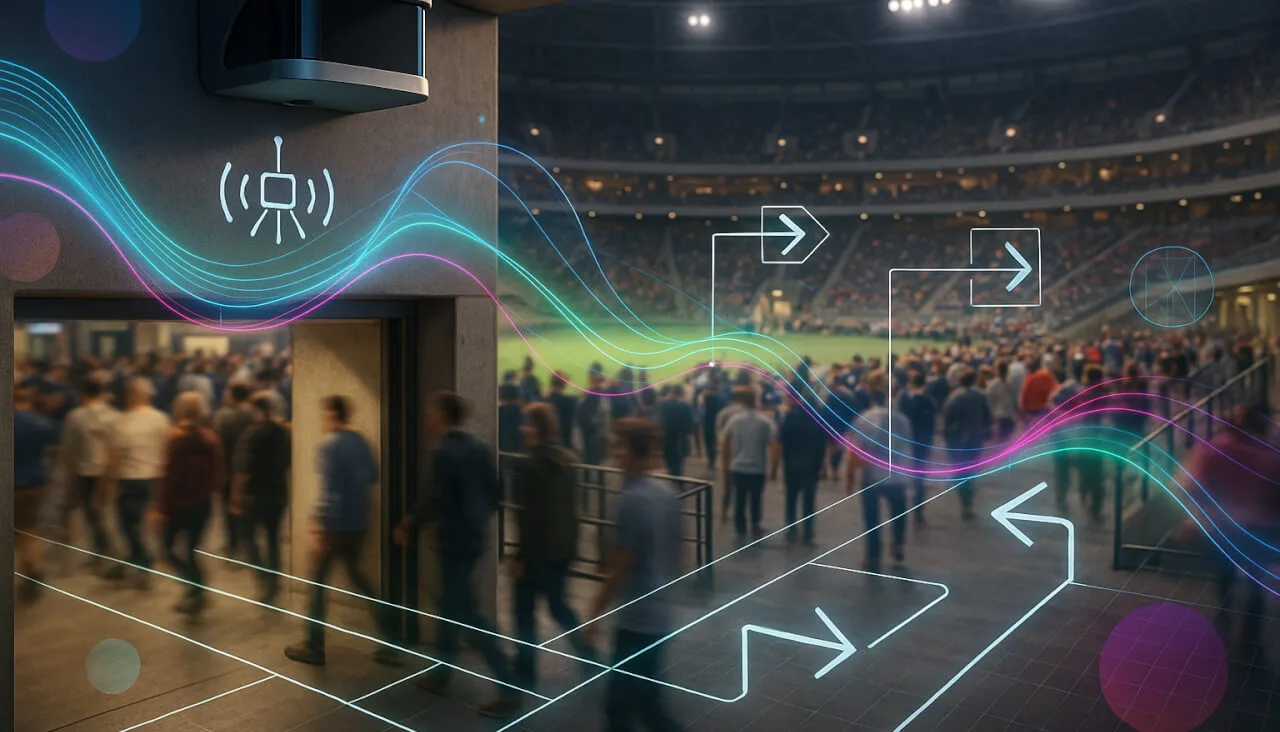
A photorealistic sports stadium interior integrates a close-up LiDAR sensor and blurred crowds.

How LiDAR Technology Enhances Modern Sports Venues

LiDAR technology transforms sports venues by enabling real-time crowd management, optimized security, and efficient resource allocation for a seamless fan experience.


Introduction

Sports venues face unique challenges in managing large crowds, ensuring safety, and delivering a memorable experience to every attendee. Traditional monitoring solutions often struggle to provide the accuracy or real-time insights needed at scale.

In stadiums hosting over 20,000 fans, even minor delays in crowd movement can lead to significant bottlenecks at entry points.

LiDAR (Light Detection and Ranging) stands out as the most advanced technology for capturing detailed 3D spatial data. Its ability to deliver precise information about people’s movements, without compromising privacy, makes it an essential tool for venue operators seeking actionable insights.

How does Lidar work? (in detail)

3D LiDAR is a complex technology that enables unprecedented Spatial Intelligence. Many engineering choices are possible when building a new device.

Read article →

Real-Time Crowd Monitoring and Flow Management

Managing the flow of thousands of spectators is a complex task that requires both accuracy and speed. Unlike cameras or manual counting methods, LiDAR provides real-time 3D data on how people move through entrances, concourses, seating areas, and exits.

During a major tennis match in Europe, LiDAR sensors detected congestion forming at two main gates five minutes before it became visible on security cameras, allowing staff to redirect foot traffic proactively.

With this level of detail:

  • Venue managers can identify choke points before they become problematic.
  • Staff deployment becomes more responsive during peak arrival or departure times.
  • Emergency evacuation routes are continuously monitored for obstructions or unusual patterns.

By leveraging these capabilities, sports venues improve both safety outcomes and fan satisfaction throughout events.

Optimizing Venue Security with LiDAR

Security is paramount in any large gathering space. Traditional surveillance systems often rely on video feeds that require constant human attention, and may miss subtle changes in crowd behavior.

LiDAR’s precision allows security teams to detect anomalies such as unauthorized access attempts without collecting personal identifying information from attendees. This supports privacy while maintaining vigilance across sensitive areas like VIP sections or restricted zones.

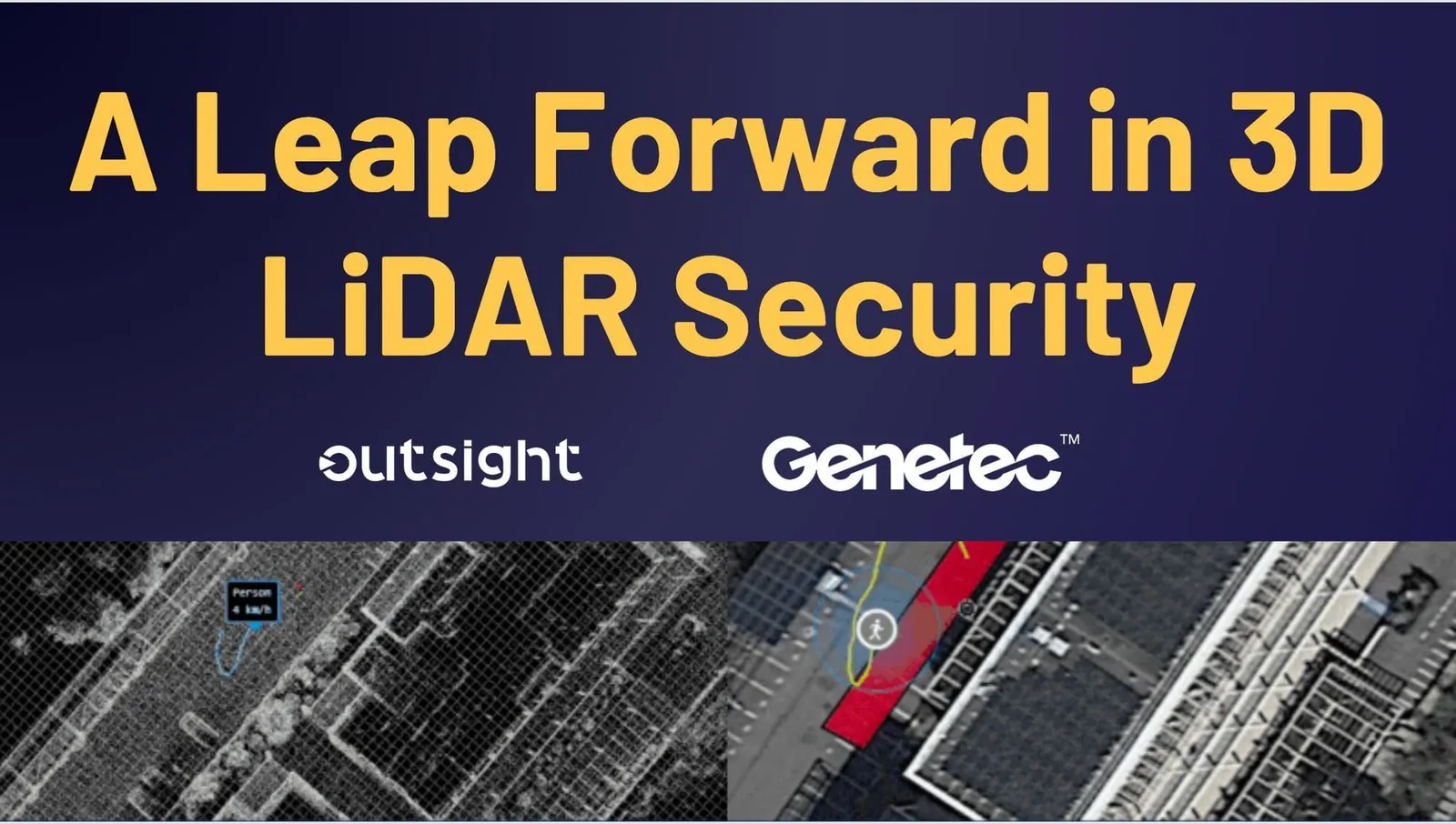
Outsight and Genetec Announce Full Integration of Their Solutions

The collaboration between two industry leaders marks a significant advancement for enhanced security solutions across many industries.

Read article →
  • Faster identification of suspicious activity.
  • Automated alerts when predefined thresholds are exceeded.
  • Improved coordination between physical security teams using objective spatial data instead of subjective reports alone.

Operational Efficiency and Resource Allocation

Efficient operations depend on knowing where resources are needed most, from cleaning crews after halftime rushes to concession stand staffing during intermissions.

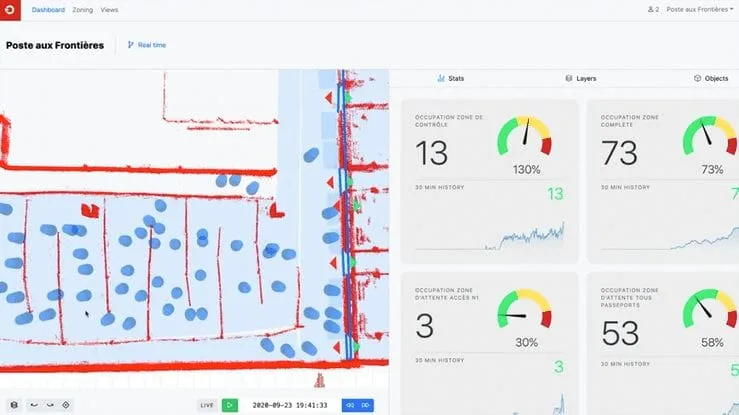
LiDAR-generated analytics help venue operators allocate personnel dynamically based on actual usage patterns rather than fixed schedules or estimates derived from ticket sales alone. This reduces waste while ensuring high-touch service where demand peaks unexpectedly.

Key operational improvements include:

  • Realigning staff shifts according to live occupancy trends.
  • Targeted maintenance scheduling based on footfall intensity.
  • Minimizing wait times at key amenities through predictive modeling informed by historical movement data.

These benefits translate into cost savings as well as improved guest experiences across all touchpoints within the venue environment.

Enabling Physical AI for Enhanced Fan Experience

Physical AI refers to systems that interpret sensor-derived physical world data, such as those collected via LiDAR, to automate responses within built environments like sports venues.

By combining machine learning algorithms with accurate spatial inputs, these platforms adapt services dynamically throughout each event day:

For example, digital signage connected with Physical AI can automatically direct fans toward less crowded restrooms during halftime surges.

Applications include:

  • Personalized wayfinding recommendations delivered via mobile apps.
  • Automated lighting adjustments responding instantly when certain areas reach capacity limits.
  • Queue management systems adjusting open service counters based on live demand projections.

The result is a smoother journey from entrance gate through every aspect of the fan experience, supported invisibly by intelligent infrastructure working behind the scenes.

Spatial Intelligence: Unlocking Data for Decision Makers

Beyond immediate operational gains lies another advantage: long-term planning driven by comprehensive Spatial Intelligence datasets gathered over multiple seasons.

Venue executives use aggregated movement maps generated by solutions like Outsight’s not only for post-event analysis but also strategic renovations:

Benefits realized include:

  • Evidence-based investment decisions grounded in objective usage statistics
  • Scenario modeling under different event types (concert vs playoff game)
  • Benchmarking against industry standards using anonymized comparative metrics

Gartner® Recognizes Outsight as a Key Player in Spatial Computing

In its latest Emerging Tech Impact Radar: Computer Vision report, Gartner identifies Outsight as a key vendor in Spatial Computing, alongside major technology players such as Nvidia, Meta, Alphabet, and Matterport.

Read article →

This approach ensures capital improvements align closely with actual user needs, not just assumptions made prior construction.

Conclusion: The Future of Sports Venues with LiDAR

As expectations rise among fans, and regulatory requirements grow more stringent, the need for reliable insight into how spaces function has never been greater.

LiDAR stands apart due to its unmatched accuracy in mapping real-world environments quickly and anonymously; combined with platforms like Outsight’s leading global deployments across iconic venues.
Related Articles

APPLICATIONS

How Spatial AI Is Transforming Crowd Management in Modern Venues

Spatial AI and LiDAR enable venues to monitor crowds in real time, improving safety, guest experience, and privacy while optimizing operations.

APPLICATIONS

LiDAR in Public Spaces: Top 6 Key Advantages for Improved Operations and Maintenance

Discover the benefits of LiDAR technology in public spaces: people counting, anonymity, public safety, easy installation, and error-free data.

Let's connect

Send us a Message

Drop your email and we'll get back to you as soon as possible.

Frequently Asked Questions

  • Can LiDAR detect crowd surges before they become dangerous at a stadium?

    LiDAR tracks every person's position and velocity continuously, so density gradients and directional flow anomalies appear in the data before they are visible to a human observer or a camera operator. Outsight's Motional Digital Twin builds a real-time, anonymous 3D replica of how people move through a space, and its sub-50ms end-to-end pipeline means an automated alert can reach a control room and trigger a staff redirect several minutes ahead of a bottleneck becoming self-reinforcing. Because LiDAR captures shape and motion rather than faces or biometric data, the detection is anonymous by definition. That combination of speed and privacy-safe sensing represents the operationally meaningful window for crowd-safety interventions in venues with tens of thousands of concurrent attendees.

  • How does LiDAR handle the privacy of fans at a sports event compared to CCTV?

    LiDAR emits laser pulses and measures how they return from surfaces. The sensor physically cannot record a face, a jersey number, or any biometric attribute because it captures geometry, not pixels. No post-processing anonymization step is required, and no identifiable image is ever created. This is why Outsight describes its LiDAR-based Motional Digital Twin as anonymous by definition: the underlying data consists of shapes and motion vectors, never faces or biometric signatures. CCTV, by contrast, records recognizable images that must be handled under data-protection law. For a venue operator, the practical difference is that LiDAR-based crowd analytics can run across the entire bowl, including seating areas, without triggering the consent or retention obligations that video surveillance does.

  • What LiDAR sensor placement works best inside a large stadium bowl?

    Infrastructure-mounted placement, sensors fixed to catwalks, roof rings, or upper-tier fascia boards, provides the widest unobstructed line of sight to concourse and seating zones. Mounting sensors in the infrastructure rather than on staff or roving equipment produces a shared, site-wide 3D point cloud where any person occluded from one sensor remains visible to at least one other. This is precisely the approach Outsight formalizes as Infrastructure-based Physical AI, where LiDAR is deployed in the built environment to generate a Motional Digital Twin of everyone moving through the space. The resulting shadowless perception reduces the total sensor count needed compared to column-mounted or ground-level alternatives, which is relevant given the physical constraints of most stadium builds.

  • Can the same spatial intelligence platform used during a match also work for a post-event concert?

    Yes. The underlying sensor infrastructure stays fixed; the operator reconfigures zones of interest, capacity thresholds, and alert rules to match the new event layout. A football pitch configuration puts crowd load on the lower concourses and gates, while a standing-floor concert redistributes density toward the infield and changes the egress pattern entirely. This is precisely how a Motional Digital Twin works: because the 3D map of the venue is persistent across events, the same infrastructure-based sensing layer serves both use cases without redeployment. Historical movement data from a concert night is then directly comparable with match-day data, which supports the kind of scenario modeling that informs future renovation or programming decisions. Outsight's SHIFT platform enables that cross-event analytics layer on top of a single, continuously operating sensor network.

  • How does LiDAR-based wayfinding differ from Bluetooth beacon wayfinding inside a stadium?

    Bluetooth beacons require each fan to have a paired app running on a phone, meaning coverage is limited to opted-in users and degrades in areas with poor BLE penetration or high device density. LiDAR detects every person regardless of what they carry, and the flow data feeds digital signage or app recommendations based on observed crowd state rather than a sampled subset. Outsight's infrastructure-based approach, deployed across major transit hubs and venues through the SHIFT platform, demonstrates this advantage at scale: occupancy and flow estimates reflect the full population moving through a space, not a biased sample skewed toward younger or more tech-engaged attendees. Because LiDAR detection is entirely independent of device ownership, wayfinding systems built on that data produce guidance that holds accuracy across all demographic groups and crowd densities.

  • Does a sports venue need to replace its existing security cameras to add LiDAR?

    No replacement is required. LiDAR integrates as an additional sensor layer, providing the 3D spatial backbone that existing cameras lack. Cameras remain useful for post-incident review and identity-linked investigations, tasks LiDAR is not designed for. The two technologies are complementary: LiDAR assigns every person a persistent anonymous ID and tracks their trajectory across the entire venue, while cameras supply the visual record attached to specific fixed locations. Outsight's SHIFT platform is built around this principle, ingesting LiDAR data to feed live operational dashboards and automated alerts while leaving existing camera workflows untouched. Most deployments run both systems in parallel, with each technology handling the tasks it does best.