Skip to content
Insights
Overview of diverse real-world applications powered by Outsight’s 3D LiDAR technology, from airports and retail to autonomous vehicles, robotics, and smart infrastructure.

LiDAR Software: An Overview of Solutions and Use Cases

Outsight's software combines LiDAR data from different sensors, converting this data into actionable KPIs in a user-friendly dashboard that supports many industries.


The software from Outsight combines 3D RAW LiDAR data from different sensors, even from different LiDAR manufacturers, and processes these data streams to create a virtual 3D LiDAR sensor in real time.

The virtual sensor output is then converted into actionable KPIs, tailored for each application purpose, in a user-friendly dashboard. The developed solution can also trigger event-based alarms and generate aggregated data analytics.

Lastly, thanks to the API and an open standard data output format, anyone can build their own custom solution, no matter what the hardware input protocol is.

In one way with the dashboard or another with the API, the LiDAR software is the smartest path to the success of any LiDAR project thanks to its fast and easy deployment, advanced tools, and world-class performance.
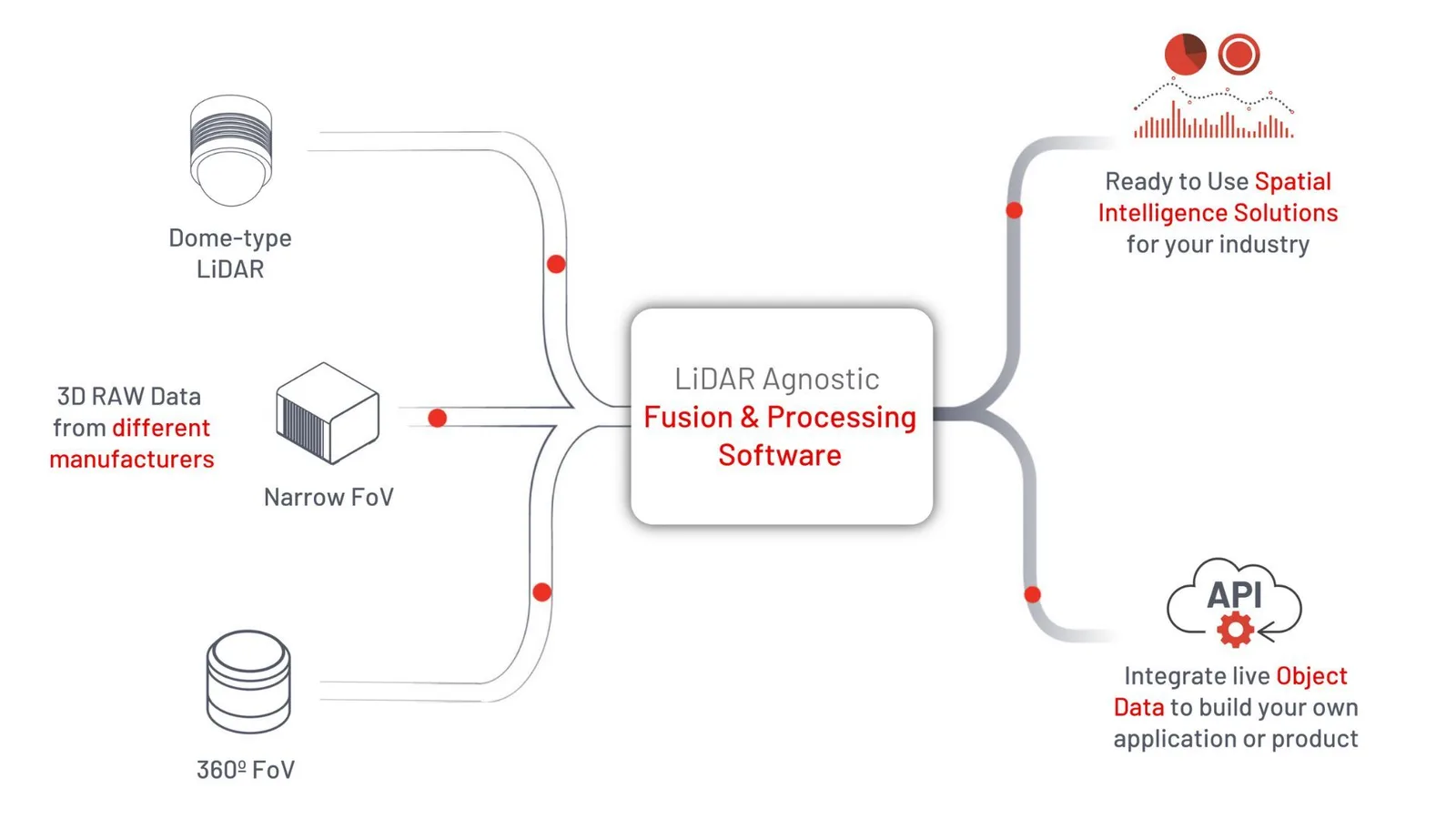
Overview of outsight processing software

Through different applications, Outsight’s LiDAR software and tools could support many industries, such as smart cities, logistics, automated vehicles, and robotics. Let’s dive in to explore some of the most relevant use cases.

LiDAR Software Use Cases

ITS

LiDAR technology has vast potential in the field of ITS (Intelligent Transportation Systems), including traffic monitoring, smart intersections, detecting VRUs (Vulnerable Road Users), and enhancing road safety for both drivers and pedestrians. However, its widespread adoption has been hindered by the complex data output that arises from using multiple LiDARs with different orientations and positions, particularly in smart traffic solutions.

To overcome this challenge, Outsight’s LiDAR Software offers a comprehensive set of user-friendly features and generates valuable information on object detection, speed, trajectory, and classification, turning raw data into actionable insights.

Smart Intersection

Outsight software can achieve high precision even in large crowded areas

The software’s ability to process huge amounts of 3D raw data at the edge and convert it into narrow-band data, enables low-power wireless communication, making it a must-have solution for ITS applications.

In practice, Outsight’s LiDAR solution can collect traffic data at any intersection and provide total surveillance to get a full traffic view (including pedestrians, vehicles, cyclists, vulnerable users, etc.).

In the city of Bellevue (WA), Outsight’s LiDAR software was used to detect pedestrians and vehicles, get their trajectory and speed, and classify them to create an intersection management tool. The project ultimate goal was to reduce the number of fatal and serious injury traffic collisions to zero.

Smart Intersection using Lidar

Outsight software enables the user to follow objects processing in real-time

In a different application example, a European company specializing in providing top-notch products for the Smart Mobility & ITS industries selected Outsight’s LiDAR software to monitor fast-moving objects and calculate the distance between vehicles on highways in order to avoid tailgating.

To know more about ITS applications, read the following article:

LiDAR Software Expands ITS Solutions

With the global rise of 3D sensor demand, LiDAR has never been so accessible and it’s becoming essential for Intelligent Transportation System applications.

Read article →

Smart Airports

For this use case, Outsight developed the Spatial Intelligence Platform (SIP), which is a plug-and-play solution for monitoring airport operations and measuring key performance indicators (KPIs) related to how people move through airports and how well they use their assets.

Outsight’s SIP boasts an unparalleled ability to continuously monitor the journey and interactions of each passenger throughout expansive Terminal areas. This enables both immediate alert generation and comprehensive data analysis

The SIP can be accessed by authorized airport staff through an easy-to-use web dashboard. It can be used in different parts of the terminal, such as check-in, immigration, security, and boarding gates.

Smart Airports using Lidar

SIP dashboard illustration

With advanced features like automatic detection of passenger queues, the SIP provides valuable insights for real-time decision-making and long-term planning and optimization.

The SIP has already been put to use in major airports, where it has processed more than 4 billion 3D data points. This is a big improvement over the old ways of tracking passenger flow and asset utilization.

Physical AI by Outsight

Outsight SIP’s hardware agnostic architecture is designed for extreme scalability

Also, Outsight’s SIP puts data privacy and GDPR compliance at the top of its list of priorities, protecting passenger information. Unlike cameras, LiDARs do not collect any personally identifiable information about passengers, and Outsight takes it a step further by processing all data on-premises and providing a private web dashboard.

Point-cloud data by Outsight

LiDAR technology and software only generate anonymous data

To know more about Smart Airport applications, read the following article:

LiDAR Manages Increased Airport Traffic

See how and why Airports are increasingly using LiDAR-based software solutions to tackle their biggest challenges, leveraging the unique value of Spatial Intelligence.

Read article →

Industrial Volume Measurement

Accurate volume measurement is a key part of operations optimization because it makes it possible to keep track of inventory and measure material stockpiles. However, it might be hard to measure the volume of large, oddly shaped objects in real time.

With the right software, 3D LiDAR technology can solve problems with measuring volume by doing a thorough scan of the surface of the target material, making a precise 3D point cloud image, and using the surface’s spatial information to figure out the volume of the target material instantaneously.

Volume measurement

LiDAR software was used to measure volumes from truck loads to large warehouses inventory

In a practical example, a leading research firm in the pulp and paper industry selected Outsight’s software for a 3D LiDAR solution that makes rapid and automated measurements of the volume of large quantities of fiber loads delivered by truck, providing the necessary information to guarantee that the lot is correct.

In a different use case, Outsight LiDAR software was chosen to calculate the volume of a warehouse inventory, the number of inventory bags in each heap, and identify people moving around the warehouse. If an abnormal and unexpected volume change occurred, an alarm would be triggered and a video would be provided for alarm verification. The next image shows a screenshot of the solution interface.

Camera view

Robotics

LiDAR technology is being used more and more to give robots the ability to see, recognize, and avoid obstacles in their surroundings. LiDAR sensors give robots information in real time that lets them do a wide range of tasks by themselves in different fields, such as warehouse logistics, industrial automation, deliveries, security, and research projects.

As a use-case example, an offshore navigation robot has used Outsight’s LiDAR software features such as 6 DoF SLAM and re-localization to get accurate and reliable information about its location and to navigate autonomously through different plant floor levels in reference to a pre-established map.

Robot

The mobile robot inspects offshore power plants in a multi-level environment using Outsight software

A European defense company, on the other hand, has used LiDAR software to provide processed 3D images and data that will help operators control robots and their arms more precisely, with the ultimate goal of neutralizing a suspicious parcel or package.

Since the robot is controlled by an operator via a wireless connection, in many situations the operator can’t really see the environment around the robot. So, the software feature super-resolution made it possible to make very accurate LiDAR 3D images that helped operators get the precision they needed to keep working.

Robot using Lidar

Outsight software capabilities are critical for successfully neutralizing potential threats

Conclusion

LiDAR technology, equipped with Outsight’s software features, has enabled numerous 3D perception applications.

Also, the technology’s inherent qualities, like being able to work during the day and night or not capturing personal information, make it even more appealing to different sectors.

In a nutshell, using LiDAR technology and Outsight’s software would be very helpful for almost any business or industry that needs spatial intelligence or accurate object detection and tracking.

If you want to know more, contact a product specialist.


Related Articles

APPLICATIONS

The Top 101 Applications of LiDAR

LiDAR can make anything that moves, observes other moving things, or needs to measure volumes smarter and safer. That makes for many applications!

APPLICATIONS

63% of 2027 LiDAR Applications Will Be Outside Automotive

By 2027, 63% of the LiDAR market, hardware and software, will be outside of the automobile industry, according to the Yole Group. Read on to discover how.

Let's connect

Send us a Message

Drop your email and we'll get back to you as soon as possible.

Frequently Asked Questions

  • What is the difference between LiDAR software and LiDAR hardware in a smart city deployment?

    LiDAR hardware captures raw point clouds: millions of 3D coordinates per second. Without software, those points are unusable. LiDAR software fuses streams from multiple sensors (even across manufacturers), runs perception algorithms to classify objects and extract trajectories, and compresses the output into structured KPIs that fit low-bandwidth wireless links. The hardware is a commodity; the software layer is where operational value is produced. Outsight, for instance, is a hardware-agnostic software vendor compatible with over 210 sensor models across brands like Hesai, RoboSense, and Velodyne, and does not manufacture sensors. In smart-city deployments such as the City of Bellevue's Vision Zero intersections, this separation matters: the SHIFT platform ingests data from existing infrastructure sensors and delivers real-time analytics without requiring a specific hardware vendor.

  • How does LiDAR software handle data from sensors pointing in different directions at an intersection?

    Each sensor has its own coordinate frame, so raw point clouds from sensors at different angles and heights describe the same physical object with conflicting coordinates. The software applies a calibration transform to each sensor's output, then merges the frames into a single unified 3D scene. Object detection and tracking then run on that merged scene rather than on individual sensor feeds, which eliminates duplicate detections and blind zones between sensors. Outsight's SHIFT platform applies this approach at infrastructure scale, fusing multi-vendor LiDAR inputs into a real-time unified scene with sub-50ms end-to-end latency, as demonstrated in smart-city intersection deployments such as the City of Bellevue's Vision Zero program.

  • Can LiDAR software measure irregular-shaped stockpile volumes accurately in real time?

    Yes. LiDAR software builds a dense 3D surface model from point cloud data, then computes the enclosed volume by integrating the surface geometry against a reference plane, typically the ground or container floor. Because LiDAR pulses return from every exposed surface regardless of shape, irregular geometry such as a fiber load on a truck or a warehouse heap is captured as accurately as a rectangular pallet. The key constraint is sensor coverage: blind zones from a single sensor angle introduce error, which is why deployments often use two or more sensors at different vantage points. Outsight's SHIFT platform addresses this through multi-vendor LiDAR compatibility, allowing operators to combine sensors from different manufacturers at complementary angles, merging their point clouds into a single real-time 3D model that minimizes coverage gaps and delivers sub-50ms end-to-end processing.

  • Why does LiDAR software output narrow-band data even though raw point clouds are large?

    A single LiDAR sensor can generate hundreds of megabits per second of raw point cloud data. Transmitting that volume over low-power wireless links at every intersection or gate is impractical. LiDAR processing software runs at the edge, close to the sensor, and reduces the raw stream to a structured feed of tracked objects with attributes such as position, speed, class, and trajectory. This output is orders of magnitude smaller, typically kilobits per second per sensor, making it compatible with cellular or mesh IoT links without sacrificing spatial precision. Outsight's SHIFT platform follows exactly this pattern: its sub-50ms edge pipeline converts raw point clouds into anonymous object-level data before transmission, delivering actionable KPIs to operators across airports, train stations, and factories without flooding the network with unprocessed sensor output.

  • What is a virtual LiDAR sensor and why merge several LiDARs into one?

    A virtual LiDAR sensor is a single, unified 3D data stream that software builds in real time by combining raw data from several LiDAR sensors, even from different manufacturers. Outsight's software creates this virtual sensor and converts its output into actionable KPIs tailored to each application, shown in a dashboard, along with event-based alarms and aggregated analytics. An API and an open standard data output format let developers build custom solutions whatever the hardware input protocol. Merging sensors this way covers large areas, such as airport terminals or intersections, as one coherent scene.

  • How is LiDAR software used in robotics for navigation and remote operation?

    In robotics, LiDAR software gives machines real-time information to see, recognise and avoid obstacles. An offshore inspection robot used Outsight's 6 DoF SLAM and re-localisation features to know its exact position and navigate autonomously across different plant floor levels against a pre-established map. A European defence company used the super-resolution feature to produce highly accurate 3D images for operators remotely controlling a robot and its arm to neutralise a suspicious parcel. In both cases the software turned raw LiDAR data into the precision the task required.

  • How was LiDAR software used at intersections in Bellevue, Washington?

    In the city of Bellevue, Washington, Outsight's LiDAR software was used to detect pedestrians and vehicles, get their trajectory and speed, and classify them in order to create an intersection management tool. The project's ultimate goal was to reduce the number of fatal and serious injury traffic collisions to zero. The article presents it as one of its Intelligent Transportation Systems examples, where the software turns raw 3D data into information on object detection, speed, trajectory and classification.

  • Can LiDAR software detect tailgating by measuring the distance between vehicles on a highway?

    Yes. A European company specialising in products for the Smart Mobility and ITS industries selected Outsight's LiDAR software to monitor fast-moving objects on highways. The software calculates the distance between vehicles in order to avoid tailgating. For ITS applications, Outsight's software generates information on object detection, speed, trajectory and classification, turning raw 3D data into actionable insights. Its ability to process 3D raw data at the edge and convert it into narrow-band data enables low-power wireless communication.

  • What is the Spatial Intelligence Platform (SIP) and which airport areas can it monitor?

    The Spatial Intelligence Platform (SIP) is a plug-and-play solution developed by Outsight for monitoring airport operations. It measures key performance indicators on how people move through airports and how well assets are used. Authorized airport staff access it through an easy-to-use web dashboard, and it can be used across check-in, immigration, security and boarding gates. Features such as automatic detection of passenger queues support both real-time decisions and long-term planning.

  • How much 3D data has the airport Spatial Intelligence Platform processed in operation?

    At the time of the article, Outsight's Spatial Intelligence Platform had already been put to use in major airports, where it had processed more than 4 billion 3D data points. The article presents this as a big improvement over older ways of tracking passenger flow and asset utilization. The platform continuously monitors the journey and interactions of each passenger throughout expansive terminal areas. Its hardware agnostic architecture is designed for extreme scalability.

  • Where is passenger data processed in the airport platform: on-premises or in the cloud?

    According to the article, Outsight's Spatial Intelligence Platform processes all data on-premises and provides a private web dashboard to authorized airport staff. The platform puts data privacy and GDPR compliance at the top of its priorities. LiDAR collects no personally identifiable information about passengers, and the on-premises processing adds a further layer of protection. LiDAR technology and Outsight's software therefore only generate anonymous data.

  • How can LiDAR software check the volume of fiber loads delivered by truck in the pulp and paper industry?

    A leading research firm in the pulp and paper industry selected Outsight's software for a 3D LiDAR solution that makes rapid and automated measurements of the volume of large quantities of fiber loads delivered by truck. It provides the information needed to guarantee that the lot is correct. With the right software, 3D LiDAR scans the surface of the target material, creates a precise 3D point cloud and uses the surface's spatial information to figure out the volume instantaneously.

  • Can LiDAR software raise an alarm when warehouse inventory volume changes unexpectedly?

    Yes. In one use case, Outsight's LiDAR software was chosen to calculate the volume of a warehouse inventory, count the number of inventory bags in each heap and identify people moving around the warehouse. If an abnormal and unexpected volume change occurred, an alarm would be triggered. A video would then be provided for alarm verification. More broadly, Outsight's software can trigger event-based alarms and generate aggregated data analytics from LiDAR data.

  • Can developers build their own applications on LiDAR software through an API?

    Yes. Outsight's software offers an API and an open standard data output format, so anyone can build their own custom solution, whatever the hardware input protocol. Users can work through the ready-made dashboard, with actionable KPIs, event-based alarms and aggregated analytics, or through the API for custom development. The article describes both paths as ways to reach success in a LiDAR project, thanks to fast and easy deployment, advanced tools and strong performance.

  • What traffic information does LiDAR software extract for Intelligent Transportation Systems?

    For Intelligent Transportation Systems, Outsight's LiDAR software generates information on object detection, speed, trajectory and classification, turning raw 3D data into actionable insights. At an intersection, this gives a full traffic view including pedestrians, vehicles, cyclists and vulnerable road users. These outputs support traffic monitoring, smart intersections, detection of vulnerable road users and road safety for drivers and pedestrians. The software keeps high precision even in large crowded areas.

  • Does LiDAR-based object detection work at night, and which industries rely on it?

    Yes. One of LiDAR's inherent qualities is that it works during the day and at night, and it captures no personal information, which makes it appealing across sectors. Equipped with Outsight's software, it supports smart cities and ITS, smart airports, logistics, industrial volume measurement, automated vehicles and robotics. The article concludes that this combination is useful for almost any business that needs spatial intelligence or accurate object detection and tracking.

  • What is the return on investment of a people flow monitoring system?

    Returns come from several sources that operators can measure directly. Staffing and lanes matched to real demand reduce labour costs and waiting times, better knowledge of footfall and dwell supports higher retail and commercial revenue, and measured use of space helps defer or right-size expensive expansions. Fewer security false alarms and safer curbside or intersection operations add further value. Outsight's Spatial Intelligence Platform supports these outcomes, and its simulator defines the hardware budget upfront so the business case can be built before deployment.