Skip to content
Insights
Security looking at multiple monitors

Surveillance and Intrusion Detection: The Evolution of 3D LiDAR Security Technology

3D LiDAR Security Solutions offer a proactive approach. These systems can detect intruders in real-time, reduce false alarms, and enhance overall security effectiveness.


A new and exciting technology emerges every few years, stimulating a paradigm shift in how physical security systems are designed, implemented, and deliver new intelligence sources.

Many of the most impactful technologies launch quietly, typically introduced by new industry players.

From the transition from analog to IP devices to the latest advancements in unified AI-driven management platforms, IoT, and cybersecurity, numerous solutions were initially met with skepticism but have now become fundamental technologies that redefine enterprise-level systems.

Joining this list is the next significant advancement in physical security – 3D LiDAR-based Perimeter Intrusion Detection.

Understanding LiDAR-Based Technology in Security Surveillance

3D LiDAR Security Solutions advance Spatial Intelligence by mapping environments in 3D and classifying objects to distinguish between people and vehicles.

Understanding the basics of 3D LiDAR Technology

Light Detection and Ranging, also known as LiDAR, is a technology for remote sensing that is used to measure distances in an environment.

Read article →
These solutions transition security systems from reactive to proactive, triggering real-time alarms and notifying security personnel of potential threats, significantly enhancing real-time surveillance and intrusion detection systems.

LiDAR (Light Detection and Ranging) is pivotal in Spatial Intelligence Platforms, using eye-safe lasers to measure distances by recording the time it takes for the light to reflect back from objects.

This data generates a 3D point cloud image, providing spatial and depth information. Integrated with Outsight’s Spatial Intelligence Platform, 3D LIDAR data allows for real-time object identification, classification, and tracking. Combined with a VMS, it forms a comprehensive security system.

3D LiDAR Security vs. Traditional Approaches

Traditional security measures often foster a false sense of security. Systems based on access control and surveillance cameras react to incidents rather than preventing them.

For example, access control might alert to tailgating too late, and surveillance footage is only useful after the fact.
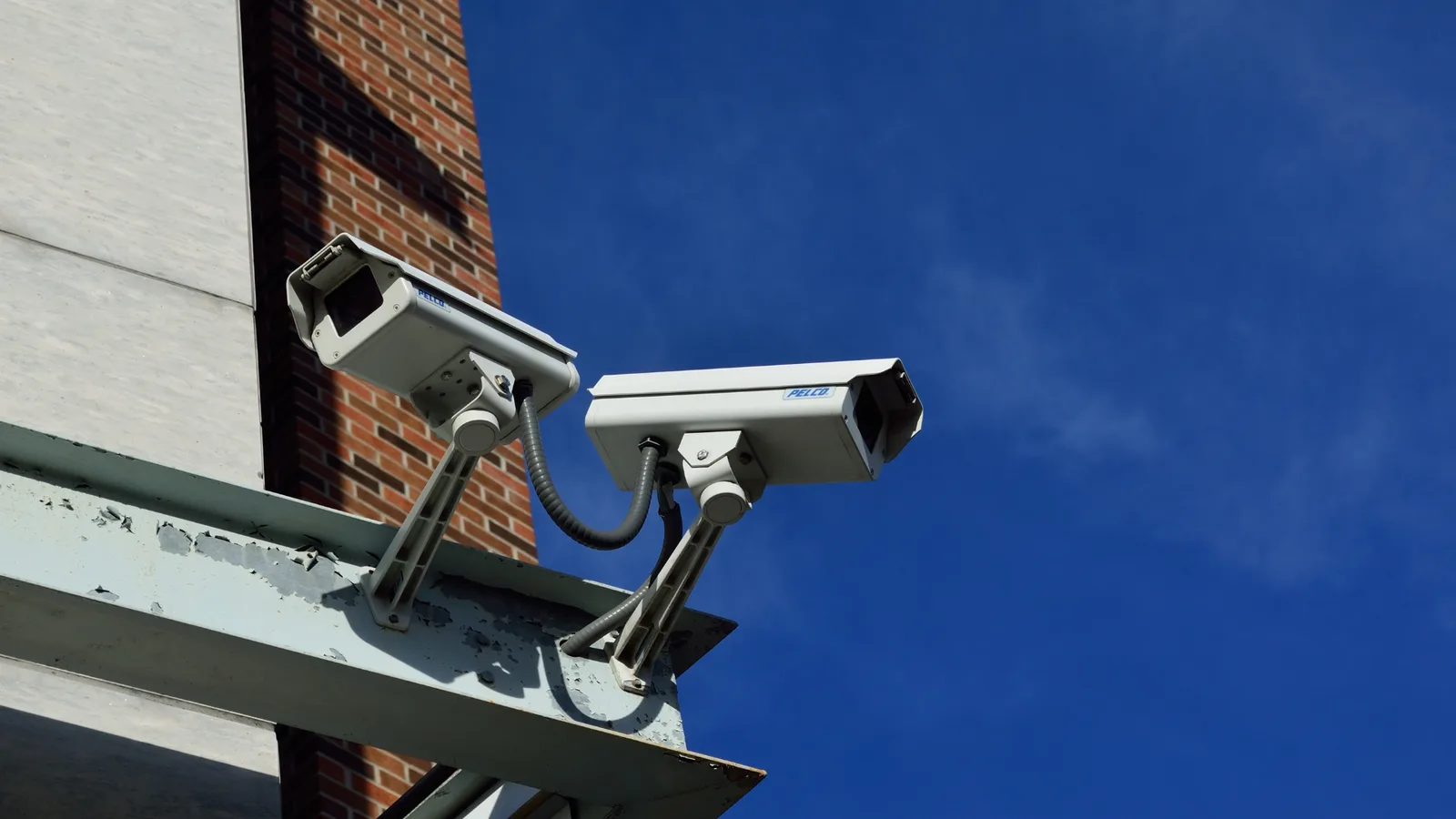
Traditional cameras

However, these ‘reactive’ security systems can’t stop an intrusion as it happens. When an access control system signals an alert for tailgating or a crime is seen on a surveillance video, the event has already occurred.

In contrast, 3D LiDAR security solutions enhance surveillance by alerting personnel to perimeter intrusions in real-time and actively preventing crimes.

They operate effectively under any environmental conditions without reliance on external lighting, making them ideal for challenging environments like energy substations.

Unlike traditional cameras that provide limited 2D perspectives, LiDAR sensors deliver detailed 3D images over a 360° field, comprehensively identifying exact locations of potential intrusions and tracking movements.

Smart intrusion detection software within these systems further enhances their capability by differentiating between types of moving objects, thereby enriching the spatial monitoring within a given area.
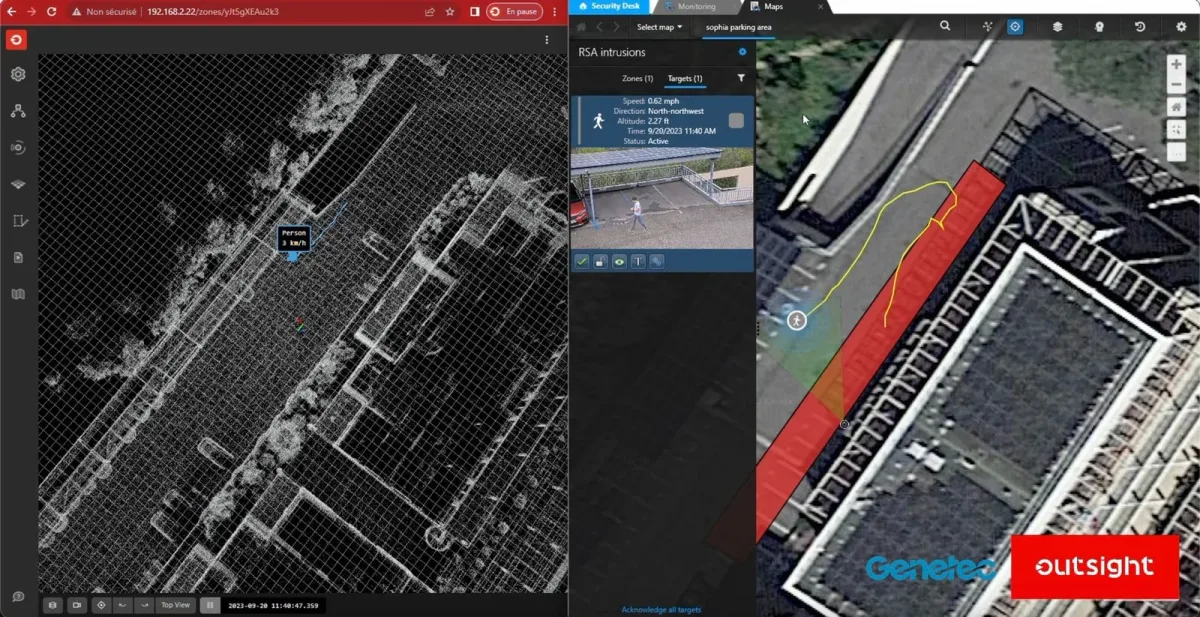
Outsight Shift immediately detects intrusion and continuously tracks the trajectory

Outsight Shift immediately detects intrusion and continuously tracks the trajectory.

This capability not only improves real-time surveillance but also significantly boosts the effectiveness of intrusion detection systems.

LiDAR Sensors and CCTV Systems: Complementary Technologies

Rather than competing, LiDAR-based intrusion detection systems enhance CCTV capabilities by directing PTZ cameras to precisely focus on and track potential threats.

This integration allows for continuous monitoring, even if an object temporarily moves out of direct sight.

The next video shows a LiDAR-based security solution with a PTZ integration within a Milestone VMS. The LiDAR software solution can automatically point PTZ cameras toward a suspicious person or vehicle.

Since advanced 3D LiDAR sensors offer complete 360° 3D coverage and can cover areas up to 15,000 square meters per sensor, they can significantly reduce the need for multiple hardware components, software installations, cabling, networking setups, and installation efforts.

This reduction in requirements ultimately lowers the overall system costs.

Additionally, it’s essential to highlight that 3D LiDAR solutions alleviate privacy concerns compared to camera-based systems or facial recognition technology.

LiDAR sensors do not capture facial images or any personally identifiable information, ensuring compliance with stringent privacy regulations. This feature makes them well-suited for deployments in regulated environments.

As a result, 3D LiDAR solutions provide real-time surveillance and highly accurate detection, tracking, and classification capabilities across various environments and weather conditions while safeguarding personal privacy.

3D LiDAR Sees Beyond

The forward-thinking awareness provided by 3D LiDAR is crucial for protecting critical infrastructures such as data centers and energy facilities and enhancing city security while respecting privacy.

LiDAR solutions for security

LiDAR-based security systems, with the right perception software, provide smart, efficient, and automated means of preventing threats and avoiding false positive detections.

Read article →

In a world that operates in three dimensions, security solutions should, too. 3D LiDAR offers a transformative approach for organizations to secure their environments comprehensively, heralding a new era in physical security.


If you want to know more, contact our team!

Related Articles

SECURITY

Stay One Step Ahead with LiDAR Based Security Solutions

LiDAR technology is transforming the security industry by offering high-accuracy, all-weather monitoring, reducing false alarms, and enhancing perimeter & access control.

SECURITY

LiDAR solutions for security

LiDAR-based security systems, with the right perception software, provide smart, efficient, and automated means of preventing threats and avoiding false positive detections.

Let's connect

Send us a Message

Drop your email and we'll get back to you as soon as possible.

Frequently Asked Questions

  • How did physical security technology evolve from analog cameras to LiDAR-based systems?

    The progression moved through three broad phases. First, analog CCTV gave way to IP-networked cameras, which enabled remote monitoring and digital storage. Second, unified management platforms and IoT sensor feeds added access control and environmental data into a single pane of glass. Third, 3D LiDAR-based perimeter intrusion detection introduced proactive spatial awareness: instead of recording an event after it occurs, the system detects and classifies moving entities before or during a breach. Outsight's infrastructure-based approach extends this third phase further, using the SHIFT platform to build a real-time, anonymous Motional Digital Twin of a protected site so that security operators receive sub-50ms alerts tied to precise 3D positions rather than flat video frames. Each transition was initially met with skepticism before becoming a standard layer in enterprise security architecture.

  • What is the difference between a reactive and a proactive security system?

    A reactive system, such as an access control gate or a surveillance camera, generates an alert or stores footage after an event has already unfolded. Tailgating is flagged once the gate has been passed; footage is reviewed after an incident is reported. A proactive system detects the conditions of a potential breach while it is developing, tracking the trajectory of a person or vehicle in real time so personnel can intervene before a crime is completed. The practical gap between the two is response time: reactive latency is measured in minutes or hours; proactive latency can be measured in seconds. Outsight's SHIFT platform operates on a sub-50ms end-to-end pipeline, enabling the kind of real-time trajectory analysis that shifts security posture from reactive documentation to proactive intervention.

  • How does a LiDAR sensor cover such a large area with fewer devices than a camera network?

    LiDAR emits laser pulses in a 360-degree horizontal arc and measures return times to build a full 3D point cloud around the sensor. A single 3D LiDAR unit can cover up to 15,000 square meters, because it perceives in all directions simultaneously rather than capturing a fixed 2D field of view. Camera networks require overlapping fields of view from multiple units to eliminate blind spots, which multiplies hardware, cabling, and networking costs. The wider spatial footprint of each LiDAR unit reduces the total count of devices, installation labor, and software licenses needed. Outsight applies this principle at infrastructure scale through its SHIFT platform, processing LiDAR point clouds across large facilities such as airports and datacenter perimeters with a sub-50ms end-to-end pipeline, enabling broad-area coverage without proportionally scaling the sensor count.

  • How does a LiDAR intrusion detection system work alongside a PTZ camera?

    LiDAR provides continuous 360-degree positional data for every entity in its coverage zone, regardless of lighting conditions. When it detects an entity crossing a defined perimeter threshold, it passes the 3D coordinates of that entity to the PTZ camera controller, which then slews to the exact azimuth and elevation indicated, keeping the target in frame even as it moves. This removes the need for a human operator to manually aim the camera and ensures the visual recording is focused on the relevant subject from the moment of detection. Outsight applies this principle at infrastructure scale through its SHIFT platform, which delivers sub-50ms end-to-end detection latency and open integrations that allow LiDAR-sourced coordinate data to feed directly into PTZ controllers, video management systems, and security operation centers without custom middleware.

  • Why is LiDAR better suited than cameras for securing data centers and energy substations specifically?

    Both data centers and energy substations typically operate at night, in weather that degrades camera image quality, and under legal constraints that limit biometric or facial data collection. LiDAR is an active sensor: it generates its own near-infrared light and does not depend on ambient illumination, so total darkness does not degrade detection. Its point-cloud output captures shape and motion without recording any pixel data, which sidesteps the biometric and privacy compliance burden that cameras impose in regulated environments. Outsight deploys infrastructure-based LiDAR at security-sensitive facilities including data centers, precisely because the technology is anonymous by definition: shape and motion are tracked, but faces, license plates, and biometric data are never captured. The combination of all-condition operation and structural privacy compliance makes LiDAR a natural fit for these facility types.

  • Does shifting from camera-based to LiDAR-based perimeter detection require replacing an existing VMS?

    No. LiDAR-based intrusion detection is designed to integrate with existing Video Management Systems rather than replace them. The LiDAR software layer processes point-cloud data and passes structured events (entity type, position, trajectory, alarm trigger) to the VMS as a data source. Outsight's SHIFT platform follows this model, exposing open integrations so structured spatial events feed directly into platforms like Milestone or Genetec without discarding existing camera infrastructure. Operators continue to work in the same management interface they already use, and staff require no retraining on a new platform. This approach lets organizations add proactive spatial detection to an existing security stack while preserving prior investments in both hardware and workflows.