Skip to content
Insights
SNCF Gares et Connexions has chosen Outsight Spatial Intelligence Platform

Enhancing Passenger Flow at train stations: SNCF Gares & Connexions Partners with Outsight

Outsight’s 3D LiDAR software is helping SNCF Gares & Connexions optimize passenger flow at Paris Charles de Gaulle Airport by providing real-time, anonymous insights.


Outsight is supporting SNCF Gares & Connexions in a strategic initiative to optimize passenger movement and accessibility at Train Station inside Paris Charle de Galle Airport Terminal 2.

Through the deployment of Outsight’s real-time 3D LiDAR-based software, this collaboration brings a new level of precision and insight into how people move within complex transportation environments.
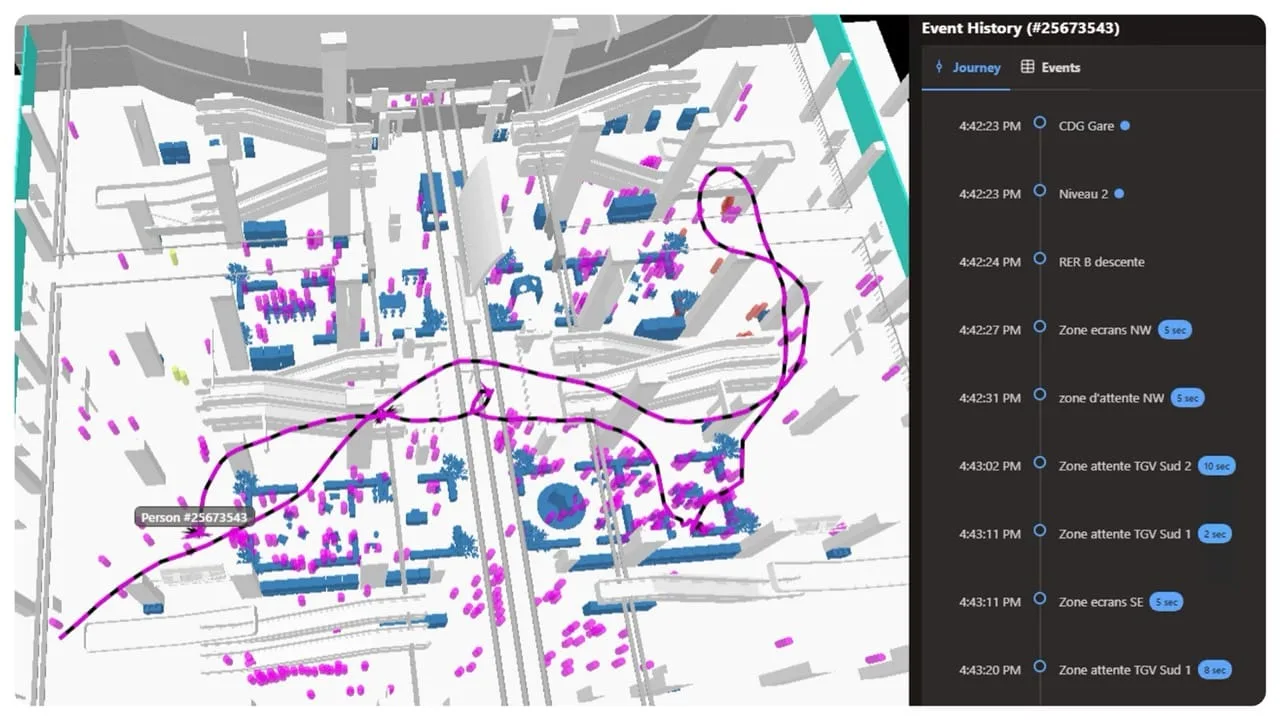
3D Spatial Intelligence software tracks how people move at Paris CDG

3D Spatial Intelligence software tracks how people move at Paris CDG

Spanning 4,000 m² across two key levels of the Paris CDG station, the initiative leverages 3D sensing technology to anonymously process spatial data and deliver high-value insights into human flow and mobility patterns, all while ensuring that no personal identifiers are captured

Outsight, Sice and FGV partner to use 3D Spatial Intelligence for Train Stations in Spain

Ferrocarrils de la Generalitat Valenciana (FGV), has launched a LiDAR-Based pilot project for rail stations in collaboration with Outsight and SICE, a leader in infrastructure management.

Read article →
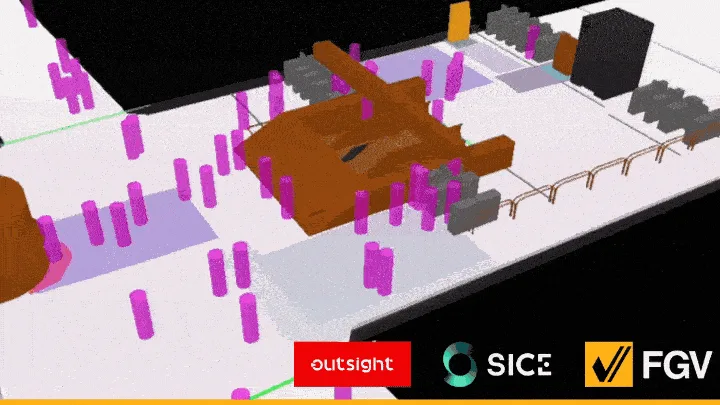
Learn more how 3D Spatial Intelligence is transforming train station in Spain

As highlighted by SNCF Gares & Connexions in their announcement:

With LiDAR, we’ll be able to know exactly how busy a station concourse is, as well as counting the number of people entering or leaving a store. This data will enable us to make the most of the commercial spaces in our stations.Philippe Dujardin, Head of Foresight and Programming at SNCF Gares & Connexions
(Translated from French to English)

Thanks to Outsight’s Spatial Intelligence solution, operators now benefit from accurate detection of mobility trends, including wheelchair access and crowd density. The software platform provides both real-time and historical data to anticipate congestion, optimize resource allocation, and improve operational efficiency. These insights also support infrastructure planning and enhanced customer service strategies.
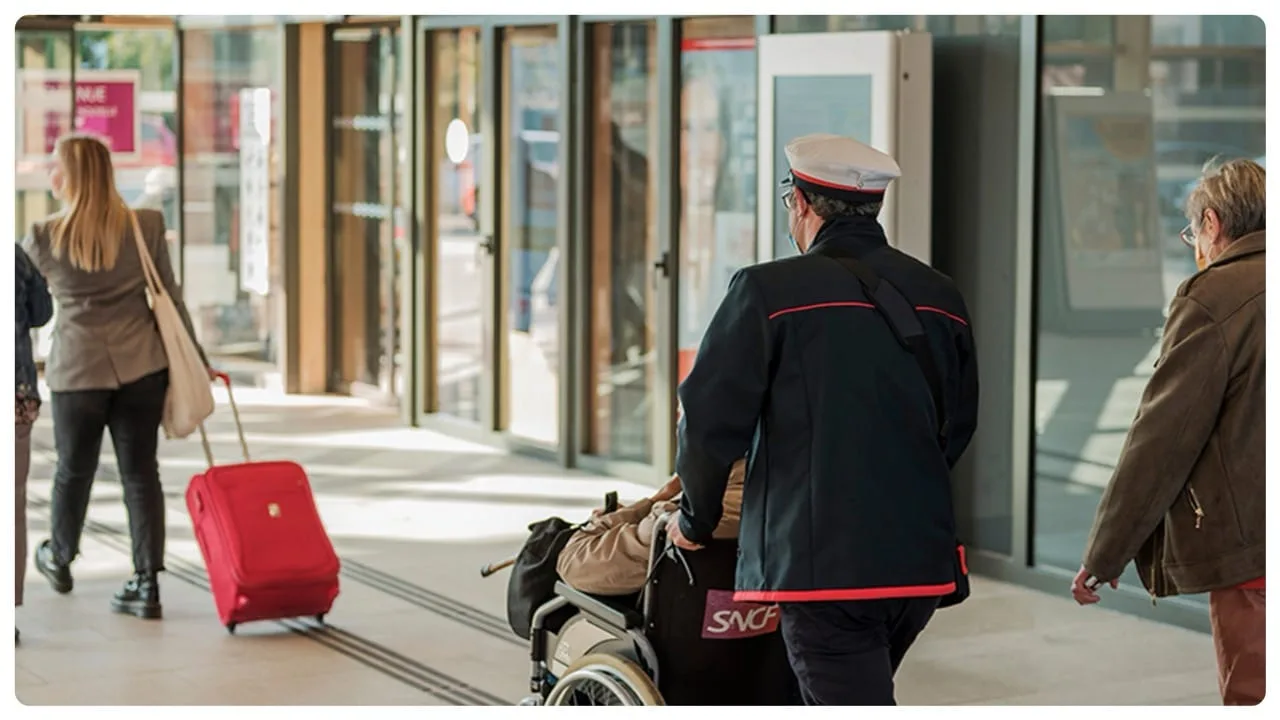
Assistance from an SNCF Gares & Connexions agent to a person with reduced mobility

A core differentiator of Outsight’s solution is its privacy-by-design approach: no video, images, or personal data is collected.

The system uses laser pulses to detect and understand motion, delivering anonymous, real-time Spatial Intelligence that fully complies with data privacy standards.

LiDAR Transforming the Railway Industry

Conventional sensors like cameras and radars struggle to meet the complex demands of the rail industry due to their numerous limitations and potential operational challenges.

Read article →
This deployment at Paris Charles de Gaulle is a strong example of how Spatial Intelligence can reshape public infrastructure. By making environments smarter, safer, and more accessible, Outsight’s 3D LiDAR-based software is helping mobility operators like SNCF Gares & Connexions improve passenger experience at scale, now and into the future.

As demand grows for scalable, data-driven tools in public transport, partnerships like this one demonstrate the value of Spatial Intelligence in meeting the operational and societal challenges of modern mobility hubs.

Related Articles

RAILWAYS

The Transformative Power of LiDAR on the railway industry

Conventional sensors like cameras and radars struggle to meet the complex demands of the rail industry due to their numerous limitations and potential operational challenges.

RAILWAYS

Outsight, Sice and FGV partner to use 3D Spatial Intelligence for Train Stations in Spain

Ferrocarrils de la Generalitat Valenciana (FGV), has launched a LiDAR-Based pilot project for rail stations in collaboration with Outsight and SICE, a leader in infrastructure management.

Let's connect

Send us a Message

Drop your email and we'll get back to you as soon as possible.

Frequently Asked Questions

  • How does LiDAR-based passenger flow monitoring work inside a train station?

    LiDAR sensors mounted in the station infrastructure emit laser pulses that measure the position, shape, and movement of every person in range. The raw 3D point cloud data is processed in real time into tracked entity streams, with each person assigned an anonymous ID from entry to exit. This is the approach Outsight applies across its SNCF Gares & Connexions deployments in France, where the system builds a continuous picture of crowd density, walking speed, queue lengths, and dwell patterns across defined zones. Because LiDAR captures shape and motion rather than facial features or biometric data, no images are produced at any stage and the pipeline is inherently privacy-preserving by definition, not by policy.

  • Can a train station flow monitoring system detect wheelchair users and passengers with reduced mobility?

    3D LiDAR classifies entities by shape and motion profile, not by camera image. A wheelchair combined with its user produces a distinct 3D bounding-box signature that differs from a standing pedestrian. The Outsight SHIFT platform, deployed for SNCF Gares & Connexions, is configured to detect and track passengers with reduced mobility separately within this framework. Because LiDAR captures geometry and movement rather than facial or biometric data, the classification remains anonymous by definition. Operators gain data to assess accessibility routes, identify bottlenecks at ramps or lifts, and improve assistance staffing decisions, all without compromising passenger privacy.

  • How does train station passenger flow data help optimize retail space inside a transit hub?

    Counting people entering or leaving individual stores, combined with concourse density mapping, gives station managers objective data on footfall per retail unit, peak trading windows, and dead-zone corridors. This replaces estimates with measured figures that can directly inform lease pricing, store placement decisions, promotional scheduling, and staffing levels. At SNCF Gares & Connexions, this commercial-space optimization use case was a core driver for deploying Outsight's Motional Digital Twin, which delivers real-time, anonymous 3D tracking of passenger movement through infrastructure-mounted LiDAR sensors rather than cameras, ensuring no biometric data is collected. Philippe Dujardin, Head of Foresight and Programming at SNCF Gares & Connexions, specifically cited this retail intelligence capability as part of the deployment's motivation.

  • What is the difference between real-time passenger flow data and historical flow data at a rail station?

    Real-time data, delivered at sub-50ms latency, feeds live dashboards and threshold-triggered alerts, allowing operators to open additional gates, reroute passengers, or deploy staff the moment congestion forms. Historical data is the accumulated record of tracked trajectories and KPIs over days or months, used for infrastructure planning, timetable optimization, identifying recurring bottlenecks at specific hours, and benchmarking the impact of layout changes. Both streams come from the same sensor pipeline; the difference is how downstream applications consume and act on them. At SNCF Gares & Connexions stations in France, Outsight's SHIFT platform delivers exactly this dual capability, combining anonymous real-time situational awareness with long-term analytics from a single 3D LiDAR infrastructure.

  • How does a multimodal hub like Paris CDG differ from a standalone airport or standalone train station when it comes to passenger flow challenges?

    A multimodal hub stacks the flow dynamics of two or more transport modes in shared or adjacent space. Passengers transfer between rail and air under time pressure, carrying luggage, navigating signage in a second language, and mixing with local commuters who move at different speeds and follow different paths. Congestion at one mode spills into the other. This interdependency means that flow monitoring at a multimodal hub must cover transition zones, not just each mode's own concourse, and that operational decisions in one mode have measurable downstream effects on the other. At Paris-Charles de Gaulle, Outsight addresses exactly this challenge through its Motional Digital Twin, which tracks movement anonymously across the full site in real time, giving operators visibility into those critical transfer zones where rail and air flows converge.

  • Does GDPR allow anonymous LiDAR tracking in public transport stations in France?

    LiDAR-based spatial tracking that never captures images, faces, or any biometric identifier does not create personal data under the GDPR definition, because there is no information that relates to an identified or identifiable natural person. The SNCF Gares & Connexions deployment powered by Outsight's SHIFT platform operates on this basis: laser pulses measure geometry and motion, producing anonymous flow statistics rather than personal records. This structural anonymity is built into LiDAR physics, not applied as a post-processing filter, which is a meaningful distinction under French and EU data protection law. A camera system that captures faces and then applies anonymization filters remains a higher-risk processing activity by comparison, because identifiable data exists at the point of capture before any filtering occurs.