
Skip to content
Insights
Outsight & AWS Partnership Agreement

Outsight and AWS Sign Strategic Partnership to Accelerate Spatial AI adoption in Aviation

Through this agreement, enterprise customers can adopt Spatial Intelligence more easily, with fast, secure integration, streamlined procurement, and faster time-to-value.


Outsight has entered into a partnership with Amazon Web Services (AWS), which includes making its Spatial Intelligence platform available on AWS Marketplace.

Outsight and AWS collaborate on large-scale deployments across transportation hubs to tackle operational challenges including security bottlenecks, crowd management, and space optimization.

Powered by advanced 3D LiDAR sensors and Edge AI, Outsight’s solutions track people and vehicles as anonymous 3D points, with no cameras, no facial recognition, and no personal data captured, at large scale.
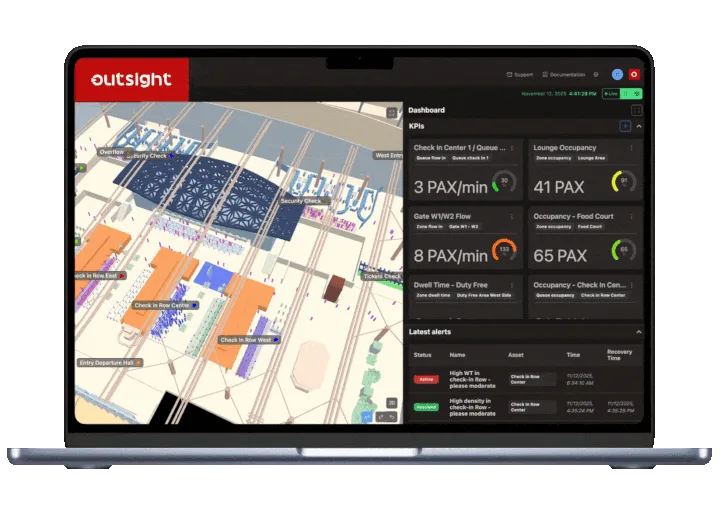
Digital Twin with Real-Time movement

Operators of airports and train stations, sports venues, road infrastructure, and industrial sites use these real-time analytics to improve operations, enhance visitor experience, and increase safety.

“It is now faster for operators to adopt privacy-first Spatial Intelligence with real-time insights at scale,” said Raul Bravo, President and Co-Founder of Outsight.

The platform is driving improvements in international airports in five continents, managing checkpoint queues and other use cases, stadiums handling large crowds, smart cities enhancing pedestrian safety and traffic flow, and industrial facilities streamlining workflows and space utilization.

Running on AWS ensures robust performance, scalability, and security, while the AWS Marketplace listing streamlines billing and integration for organizations already using AWS.

Outsight’s privacy-by-design architecture ensures compliance with GDPR and other regulations, and real-time dashboards provide actionable data for resource allocation, staffing, infrastructure planning, and security enhancements.

Digitizing Movement: The next generation of Digital Twins

Integrating people flow monitoring into Digital Twins with LiDAR and Spatial Intelligence delivers real-time insights, optimizing safety and efficiency.

Read article →

The AWS partnership further expands Outsight’s distribution channels across transportation hubs, sports venues, road infrastructure operators, and industrial sites.


Related Articles

AWARDS

Gartner® Highlights Outsight as Digital Twin leader

Recognized for pioneering real-time digitalization of dynamic environments, Outsight sets itself apart by focusing on the live monitoring of people and vehicle flows.

AWARDS

Gartner® Recognizes Outsight as a Key Player in Spatial Computing

In its latest Emerging Tech Impact Radar: Computer Vision report, Gartner identifies Outsight as a key vendor in Spatial Computing, alongside major technology players such as Nvidia, Meta, Alphabet, and Matterport.

Let's connect

Send us a Message

Drop your email and we'll get back to you as soon as possible.

Frequently Asked Questions

  • What does listing a spatial intelligence platform on AWS Marketplace actually change for airport operators?

    AWS Marketplace lets operators purchase and activate software directly against existing AWS spend commitments, which removes a separate procurement cycle and consolidates billing into one vendor relationship. For airport IT teams operating under multi-year AWS enterprise agreements, this means Outsight's SHIFT platform can be activated without a standalone contract negotiation, cutting weeks off typical deployment timelines. The software runs on the same cloud infrastructure the operator already trusts for security and compliance audits, making it easier for airports to adopt real-time 3D Spatial Intelligence capabilities across terminals and airside zones without the friction of a traditional enterprise software procurement.

  • Why would a spatial AI deployment run on cloud infrastructure rather than purely on edge hardware?

    Edge hardware handles the latency-critical work: raw LiDAR processing and entity tracking run on-site at sub-50ms to support live alerts. Cloud infrastructure handles the workloads that benefit from scale and persistence: storing months of 3D trajectory data, running demand-forecasting models across multiple sites simultaneously, and serving analytics dashboards to distributed operations teams. Outsight's SHIFT platform is built around this hybrid split, with the real-time perception layer deployed in the infrastructure on-site and longer-horizon analytics, multi-site aggregation, and integrations running in the cloud. The partnership with AWS reflects that architecture, giving enterprise customers in aviation and other sectors a faster path to procurement and deployment without forcing one layer to absorb responsibilities better handled by the other.

  • How does a privacy-by-design architecture satisfy GDPR differently from a system that anonymizes camera footage?

    A camera-based system records pixel data that can contain faces and license plates, then applies post-processing to blur or strip identifying information. If the anonymization step fails or is bypassed, personal data was still captured. LiDAR captures shape, position, and motion as 3D points: no pixel, face, or biometric is ever recorded at any stage. There is nothing to anonymize after the fact. GDPR compliance follows from the physics of the sensor, not from the reliability of a software filter. Outsight's Motional Digital Twin is built on this principle, using infrastructure-based LiDAR so that anonymity is a property of the data acquisition itself rather than a downstream process that could be misconfigured or circumvented.

  • Can the same spatial intelligence deployment cover both airside and landside at an airport?

    Yes. Infrastructure-mounted LiDAR sensors can be placed across both zones, feeding a single shared 3D point cloud. Outsight's Motional Digital Twin is built around exactly this architecture: sensors installed in the infrastructure (not on moving entities) cover any combination of zones within a site, while the SHIFT platform applies zone-level permissions so different operations teams query only their own area. Landside use cases include curbside vehicle dwell monitoring, drop-off congestion, and pedestrian flow from parking to check-in. Airside use cases include checkpoint queue measurement, gate boarding flow, and baggage claim occupancy. Deployments at airports such as Dallas Fort Worth and Paris-Charles de Gaulle demonstrate that both zones can be unified under a single analytics layer without requiring separate systems.

  • Does running spatial AI on cloud infrastructure create a latency problem for real-time safety alerts?

    Not when the architecture separates edge from cloud correctly. Safety-critical events, such as a perimeter intrusion or a person falling, require sub-50ms response and are handled entirely by on-site edge processing without a cloud round-trip. This is the approach Outsight takes with its SHIFT platform: the real-time perception pipeline runs at the infrastructure edge, while cloud infrastructure receives the processed entity stream after the fact, or at reduced frequency, for analytics workloads that do not need millisecond response. Operators can configure delivery rates per use case, trading latency headroom for lower storage and bandwidth costs on non-critical pipelines. The result is that cloud adoption accelerates deployment and procurement without compromising the latency guarantees that safety alerting demands.